Animal communication: too much to believe?

As a practicing animal communicator who is also a longtime skeptical journalist, I understand the questions about whether animal communication is legitimate. To believe we can communicate telepathically with animals can be a stretch. To believe it can happen at a distance, without benefit of phone or WiFi, is even more challenging.

In an age of science, and when we have to be careful who we trust, is this not appropriate? I say it’s very appropriate.

So why would anyone even consider that communicating with animals is possible … or work with an animal communicator in order to help a pet?

It comes down to why we believe in anything: our lived experience, the credible evidence we see, and what we stand to gain.

1976 Garlocks' lake home w Lassie & Mugsy the kitten I found
This is me at age 9 with a friend’s collie, Lassie; and a tiger kitten who’d happened by that morning. I called her Mugsy. Though I don’t remember specifics, I know I talked with both of them. Mugsy followed me around for the rest of the day.

Experience: Been there, done that

As a young person, I spent a lot of energy hiding — or shutting down — my sensitivity. I did so in order to survive bullying and generally function in the world. I still communicated with animals, but knew better than to call it that.

Like most journalists of my generation, I learned to seek reliable sources and verify everything. “If your mother says she loves you, check it out,” was the motto. I prided myself on getting the facts right, spelled correctly, and presented with perfect grammar and Associated Press style. (I still do.)

When I was about 40, my cat Idgie developed inflammatory bowel disease, hyperthyroidism, and crippling anxiety. She received good veterinary care, but at the same time, my intuition was beginning to open back up. I knew there had to be more I could do.

There were “pet psychics” on TV, but I never thought much about them. Then I heard about someone here in Fort Wayne, Indiana who did intuitive work with animals — an animal communicator, she was called. Almost before I knew what was happening, I’d emailed her about my cat and signed up for the next class.

We learned. We practiced sending and receiving information telepathically with one another. Each of us then did a distant communication with an animal whose species, age, and gender we were told, with a specific question to be addressed. 

I was stunned at the accuracy of the information I received. Holy crap, I knew this was real, but now it was tried-and-tested-real.

My cat and I began some tentative, yet heartening talks about trust, needed changes, and giving ourselves a chance. Her physical challenges continued, but there was a profound shift in the way we both viewed them. She felt heard in a new way, and we were able to move forward with more faith and less fear.

I moved through the intermediate and advanced animal communication classes over the next couple of years. We brought in photos and communicated with one another’s animal companions. We did an in-person communication with a dog our instructor brought in. Afterward, on my own, I practiced connecting with other animals.

This discipline is much more “practice” than “woo,” I discovered. I had this natural ability, but I had to use and develop it in order to truly help animals and their people. Which, I increasingly realized, was something I very much wanted to do.

Evidence: Tell me something good

Most of my clients are referred by others who have worked with me and found it helpful. Credible word of mouth beats Yelp any day. 

Show me the science on animal communication, you say? Here are a few relatively recent scientific studies indicating there’s more to interspecies communication than previously thought. As always, judge for yourself. Also recognize that we may be just scratching the surface in this field.

Dogs understand what we say and how we say it, Hungarian scientists found. They trained a group of family dogs to enter an MRI machine and scanned the way their brains responded to not only words but their tone. 

Two books reviewed in the Christian Science Monitor further delve into research on how attuned our canine companions are to our emotions, speech, and behavior. 

Cats react to the sound of their names, according to a group of Japanese scientists. 

Goats prefer positive human facial expressions, says a UK-based study. 

• Not to be outdone, 23 horses were taught by Norwegian researchers to express their needs using symbol boards.

Benefit: What use is this?

In a training session at one of the newspapers where I worked, the presenter said the WGASA principle must be considered in every story we write or publish. WGASA stands for (and I am paraphrasing here): Who gives a shilling, anyway? In other words, the information we gather and present has to be relevant and useful to our readers.

It’s the same with animal communication; what are the benefits to animals and the people who love them? Maybe your animal friend has a seemingly intractable behavior problem, or you are facing a gut-wrenching end-of-life decision. An animal communicator should, at the very least, provide a compassionate “second set of eyes” on the issue.

Moreover, if you’ve chosen a reputable animal communicator whose approach resonates with you, chances are good you’ll gain something useful. It might be a tip you can act on immediately, such as moving the litter box or taking five minutes after dinner every night to toss a tennis ball for your dog. Working with an animal communicator can also yield insights about whether your dog feels a proposed surgery would help, or why your cat doesn’t like your new gentleman caller. 

All of these things help you to have a better understanding of your animal friend, and vice versa. The result is less frustration and anxiety, and more peace of mind for all.

Is talking with animals too much to believe? You decide.

‘Symphony’ traces empathy with animals

Our-Symphony-With-Animals-Cover-Two-Thirds-Original-SizeAysha Akhtar was only five when a close family friend began molesting her. The abuse continued for five years and across two continents, after her family moved from London to Virginia. She told no one.
Then came Sylvester, a German shepherd mix technically belonging to a relative, but basically her dog. They shared friendship, kinship, walks in the woods … and abuse, as Sylvester’s owner’s idea of training was throwing him against a wall.

Akhtar, now a neurologist and public health specialist, recounts their journey and much more in Our Symphony with Animals: On Health, Empathy, and Our Shared Destinies (Pegasus Books, 2019).

Writing this book took Akhtar into not only her own history, but into a slaughterhouse, an animal sanctuary, a prison, and a forensic necropsy by an ASPCA veterinarian. She even corresponded with and visited an imprisoned serial killer who’d also abused animals. Akhtar does this both as an accomplished physician and scholar and as a human being who is deeply affected by what she sees and hears.

Through it all, she challenges us to examine the ways we break with and join with animals in our actions and attitudes. The effect one life can have on another, even and especially across species lines, is profound. It was Sylvester who helped the young Akhtar find the strength to stand up first for him, then for herself.

The stories here range from inspiring to devastating, but you can visit the author’s website for suggestions on how to make a difference. That one starfish is counting on it.


Service dogs, therapy animals, and ESAs

lkt8568_5x7low

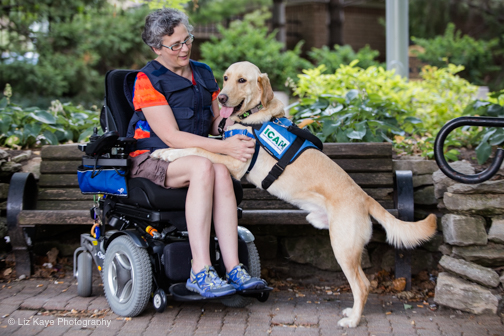
Bandit, shown here with Kristine, is a trained service dog at work — not a therapy or emotional support dog. (Photo by Liz Kaye Photography/Indiana Canine Assistant Network (ICAN).

While doing research and interviews for a magazine story on therapy animals a few years ago, I learned the important legal and functional differences between therapy animals and service animals. Now emotional support animals have entered the mix, and sometimes the headlines. What distinguishes one from another, and what does it mean for us and our animal companions?

Let’s start with a brief breakdown. The American Veterinary Medical Association summarizes each category with legal chapter-and-verse citations, and Pet Partners has a useful downloadable chart with the roles and rights of each.

Service animals

Service animals, or assistance animals, are specially, individually trained to assist or perform tasks for people with physical, sensory, psychiatric, intellectual, or other mental disabilities. This training comes from organizations such as the Indiana Canine Assistant Network (ICAN), which is the only accredited service dog training program in the state.

These are the dogs who help the blind navigate streets and shopping malls, alert someone with epilepsy of an oncoming seizure, or retrieve keys dropped by a person in a wheelchair. According to the Americans with Disabilities act, the tasks the animal performs must be directly related to the person’s disability in order for the animal to be classed as a service dog.

Yes, a service animal basically means a service dog — but miniature horses can be service animals if they are housebroken, under the handler’s control, and can be accommodated by whatever facility the handler wishes to enter. Under the ADA, service animals are allowed just about anywhere as long as they do not directly threaten public health or safety.

ellie - photo by venita lawyer:paws, inc edited

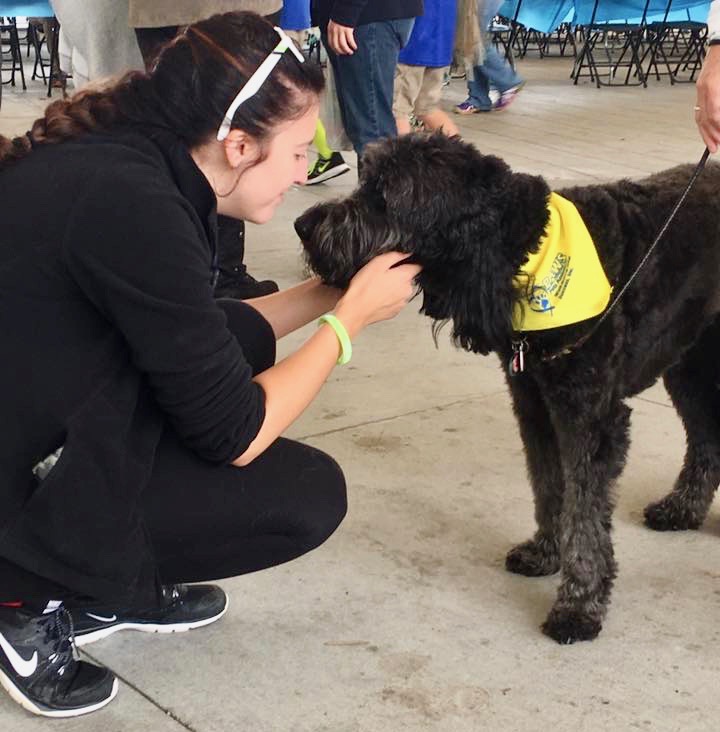
Ellie, a therapy dog with PAWS, Inc. (Pets Assisting Well-Being and Success), visits with an attendee at Fort Wayne’s Out of the Darkness walk for suicide prevention. Ellie and her human, Venita Lawyer, have worked in a variety of school and clinical settings. (Photo by Venita Lawyer/PAWS, Inc.)

Therapy animals

These are the dogs who, with their (usually volunteer) handlers, go from room to room in hospitals or listen to children read in libraries. They hang out in student commons areas during finals week and are becoming more common sights in airports.

My understanding is that most therapy animals do not undergo training (apart from canine “good citizen” classes), but they and their handlers are often members of groups such as the Alliance of Therapy Dogs or Fort Wayne’s PAWS, Inc., which works with Alliance of Therapy Dogs-registered dog handler teams.

Obviously, “therapy animals” has applied mostly to dogs. However, horses who are part of specialized riding or equine-assisted counseling programs, such as the ones at Summit Equestrian Center, are also considered therapy animals.

Then there are the resident cats in hospice wings, the birds greeting nursing home visitors in the lobby, and other animals with no training or organizational affiliation whatsoever … but somehow they became therapy animals. But none of the above carry the legal status or rights of access that service animals have.

Emotional support animals

ESAs may be of any species, but are most often dogs, and receive no specialized training. Their use is supported (or prescribed) by a mental health professional stating that the animal’s presence is necessary to treat an impairment that substantially limits one or more life activities.

ESAs do not have the same rights of access as service animals. They can accompany their people into restaurants only with permission of the owner/manager. However, under the Fair Housing Act, they may live in housing with “No pets” policies and travel in the cabins of airplanes with whatever documentation the airline requires.

Interestingly, the Air Carrier Access Act seems to treat psychiatric service animals and ESAs about the same, according to the U.S. Department of Transportation, but many of the particulars are up to the airline.

Where the lines blur

I think there is better clarity now between therapy animals and service animals. However, the distinction between a service dog for someone with a mental or psychiatric disability and an emotional support animal seems murky, as does the distinction between an ESA and a companion animal. The result is misunderstanding and often fraud.

You can go online, pay a fee, and get your dog “certified” or “registered” as an emotional support animal — never mind working with a doctor or therapist — at any number of websites. You can buy official-looking service dog harnesses, emotional support animal cards, and the like online, too (including from the popular Chewy).

If you want to get around a landlord’s pet deposit or no-pets rule, take your dog onto a plane for free, or bring him into a place where pets wouldn’t normally be allowed — and you’re willing to lie about your need and the animal’s credentials — it’s pretty easy to do. That may get you what you want, but it does so at the expense of people who have worked through legitimate channels to address their needs. It inevitably does so at the expense of the animals, too.

There have been headline-making incidents of things going horribly wrong with ESAs, their people, and others, especially in air travel. Would these things have happened if the animals involved were properly trained service dogs? Some airlines are changing their policies as a result. New laws, including in Indiana where I live, are beginning to better define emotional support animals and crack down on misrepresentation.

Working with integrity

Official distinctions may be lost on animals, but many are wonderfully clear on what they are here to do, and for whom. We can help them carry out their missions, and support other animals in finding theirs, by using good judgement about what we ask them to do and listening from the heart when they tell us.

By staying informed about the above, and all the other capacities in which humans and animals work together, we can help create a world that is more fair to the animals, the people they would aid and accompany, and the animals and people affected by their presence. There is so much we humans and animals can do and be together. If we do our work with integrity, as the fourth Reiki precept puts it, we can go a long way in helping animals do theirs.