Reiki and religion don’t have to be at odds

Some people may reject Reiki, a Japanese stress relief modality, as incompatible with the teachings of their faith tradition. Reiki is not a religion in itself; people of any spiritual stripe practice, teach and experience the benefits of Reiki. But how does that all work together?

I can only tell you how it works for me, a Presbyterian seminary graduate who found a path as an animal communicator and practitioner of Kathleen Prasad’s Let Animals Lead® meditation method. This method is a specialized form of animal Reiki.

In short: I say my prayers, show up, listen and get out of the way.

Any healing comes from God, whether that happens through me or in spite of me. My job is to create the conditions for healing by listening and holding a peaceful space for the animals and their people.

The Let Animals Lead® animal Reiki method I practice is meditation-based. It’s hands-off unless the animal wishes contact, and there is no manipulation of energy. I allow it to work however it needs to for the animal’s highest good. God knows that better than I do.

Watch me at work and all you’ll see is a middle-aged woman sitting quietly with a dog or cat, or standing in a barn or pasture. I might have Gregorian chant or other meditation music playing softly on my phone. I’m meditating but not in a trance — gotta move quick if a Percheron is about to step on my foot or goats need to be herded back from the neighbor’s field. (Those are two of many possible interruptions; the idea is to take them in stride and carry on.)

My theological grounding is Protestant Christian, but anything I believe or experience is only a tiny part of God’s big picture. Respecting your beliefs and experience is a core value in my life and practice.

I also know animals are deeply connected to a higher wisdom that sustains all of us. Whether their humans call that higher wisdom God, the universe or nothing in particular, the animals are OK with that. So am I.
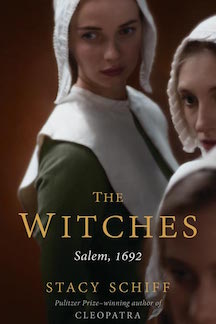
Salem: Which was witch

TheWitches

See stacyschiff.com

As we have seen, especially in recent days, fear makes people do crazy, horrific things.

It’s the same old crap we dealt with three centuries ago. The people of Salem, Massachusetts in 1692 were nothing if not scared. They lived in a new, untamed land under constant threat of Native American attack and abduction. Their Puritan beliefs had them either righteously lording it over others or falling miserably short despite their best efforts and greatest sacrifices.

The notion that there were witches among them — women (mostly) who had signed a pact with the devil and were torturing people like 12-year-old Ann Putnam — gave all that free-floating fear a place to land.

Pulitzer Prize-winning author Stacy Schiff helps us see and feel this brief but devastating chapter of American history in The Witches: Salem, 1692 (Little, Brown and Company, 2015). In particular, she helps us see the day-to-day realities that allowed it to unfold.

My interest in the Salem Witch Trials increased a few years ago when I discovered a genealogical connection to some key players. Deacon Edward Putnam is my seventh great-grandfather, and he was among the accusers whose testimonies sent several innocent people to their deaths. His older brother, Thomas Putnam, appears to have been a ringleader, and Thomas’s daughter Ann was one of the young girls whose bizarre behavior set the whole mess in motion.

This was a rare moment in history in that females, and young ones at that, were calling the shots. Betty Parris, daughter of the Reverend Parris, and her cousin Abigail Williams began to have convulsive, screaming fits. Soon Ann Putnam and other girls showed similar symptoms. A doctor said the girls were bewitched, and the girls began to name a series of local women as their tormentors, also claiming to see ghosts, spectral versions of the living, and the devil.

It was a reality show-worthy spectacle, by all accounts. Then, as now, nobody does drama like a girl on the threshold of womanhood. Then, as now, people at the bottom of the heap are apt to misuse power when they suddenly find it in their hands. If one of these young ladies accused you of witchcraft, you were as good as convicted. The only defense against an accusation of witchcraft was a good offense — shifting the accusation onto someone else.

Schiff notes that young Ann Putnam predicted future events and recalled others that predated her birth. And without question, Thomas Putnam had suffered many losses at that point in his life — inheritance, land, and children. It’s not hard to believe he was motivated to use the force of the law to settle some scores. However, as Schiff says, “Putnam had a much-loved, perceptive, desperately convulsing twelve-year-old at home. He was soon to have a deranged wife as well. It is difficult to believe he had a long-range strategy at the start.”

Thomas and his wife both died in 1699, leaving Ann to raise her younger siblings. At age 27, Ann, seeking full church membership, apologized to the Salem village congregation for her significant role in the events of 1692. Out of the 19 who had been put to death, she had testified against all but two. It was a “devil made me do it” apology, but it was more than any of the other accusers offered. She died a decade later.

If you’re looking for the Cliff’s Notes version of the Salem witch trials, or easy answers, you won’t find them in this dense, detailed work. You will, however, find the humanity behind this surreal chapter of America’s story.