
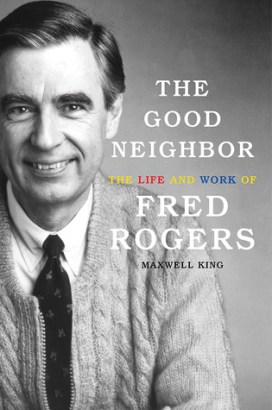
 When Fred Rogers was about halfway through his studies at Pittsburgh Theological Seminary, the faculty asked him what sort of ministry he envisioned. Rogers, who was already doing children’s television work, said he hoped to make that a ministry.
“Nothing like that had ever been fashioned from Presbyterian fabric,” relates Maxwell King in The Good Neighbor: The Life and Work of Fred Rogers (Abrams Press, 2018), “and Fred’s teachers were somewhat at a loss to guide him.”
Fortunately, one of them suggested Rogers also study child development with Dr. Margaret McFarland at Pittsburgh’s Arsenal Family & Children’s Center, which he did. He and McFarland would work together for the rest of their lives. Rogers also took graduate-level child development courses at the University of Pittsburgh.
But Pittsburgh Presbytery’s elders felt Rogers should become an assistant pastor, then senior pastor of a church, and stand up in a black robe and preach on Sundays. They refused to ordain him.
A friend from seminary, the Rev. Bill Barker, risked his own position to advocate for Rogers’ non-traditional ministry. Rogers’ television audience — kids from about 2 to 8 — was a congregation of thousands if not millions, he said at a presbytery meeting. “‘And this is a man who has been authentically called by the Lord as much as any of you guys sitting out there,'” Barker recalled telling those gathered.
The elders somewhat reluctantly relented, and Rogers was ordained in 1963.
A few years later, Mister Rogers’ Neighborhood popped up on the television landscape. The show contained no Bible verses, prayers, or mention of God. It was just this quiet, sensitive guy and his neighborhood of people, puppets, and stories. Yet the core messages of kindness, courage, and respect for self and others could not have been clearer.
As a young child, I watched “Mister Rogers’ Neighborhood” when it first aired (in black and white) on a bulky Magnavox that was more furniture than appliance. His approach spoke to a kid who didn’t like a lot of noise and flash, but appreciated a reasoned, encouraging word. The fact that Mister Rogers was also a Presbyterian minister didn’t really surprise me. I figured he was where God wanted him to be. Rogers just had that vibe of someone who pointed the way to a bigger, better reality.
There are many more layers to this comprehensive biography by King, a journalist and now CEO of the Pittsburgh Foundation. What struck me was the way Rogers, with God and the people who entered his orbit, co-created a ministry. And he did so despite the church not knowing quite what to do with him.
Rogers probably would have continued with his television ministry with or without the presbytery’s endorsement via ordination. The fact that he persisted, a friend backed him up, and the church body changed its position testifies to our ability to learn even when we don’t especially want to.
Answering a call to serve God doesn’t always take the form we expect, and sometimes the best career move is to drop our expectations and listen.
The payoff for our world could be significant.



 All Creatures