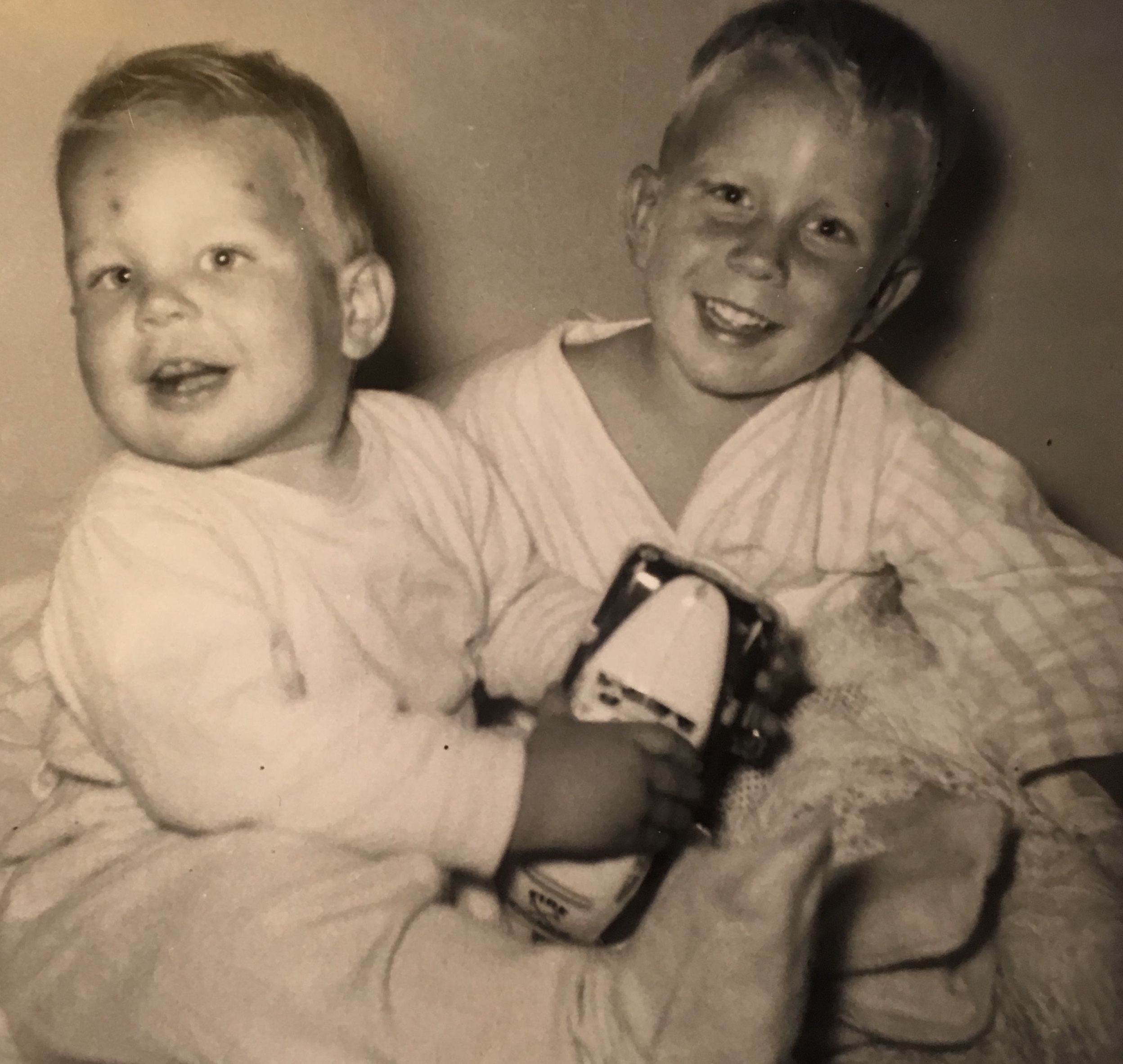
Gary, left, shown here with brother Dave, loved cars from an early age.
When Gary Crowe was 16, his life was disrupted by the arrival of a little sister (me). Very shortly thereafter, he got sick with appendicitis. So sick, in fact, that Mom and Dad had to sign off on a not-yet-approved drug in order to save his life.
Thankfully, he recovered, but he’d missed so much school that he ended up dropping out. In the 1960s, North Central High School in Indianapolis did not have programs for budding auto mechanics like him. Gary loved cars, classic cars in particular. He worked for a number of automobile shops in Indianapolis and always had a car with which he was, or had been, tinkering. One was a red MG convertible, and I remember Gary, older brother Dave, and I tooling around in it.
He moved to the San Francisco Bay Area in 1978 and worked for a car dealership, eventually heading its service department. For a few years, he lived on a 35-foot cabin cruiser.
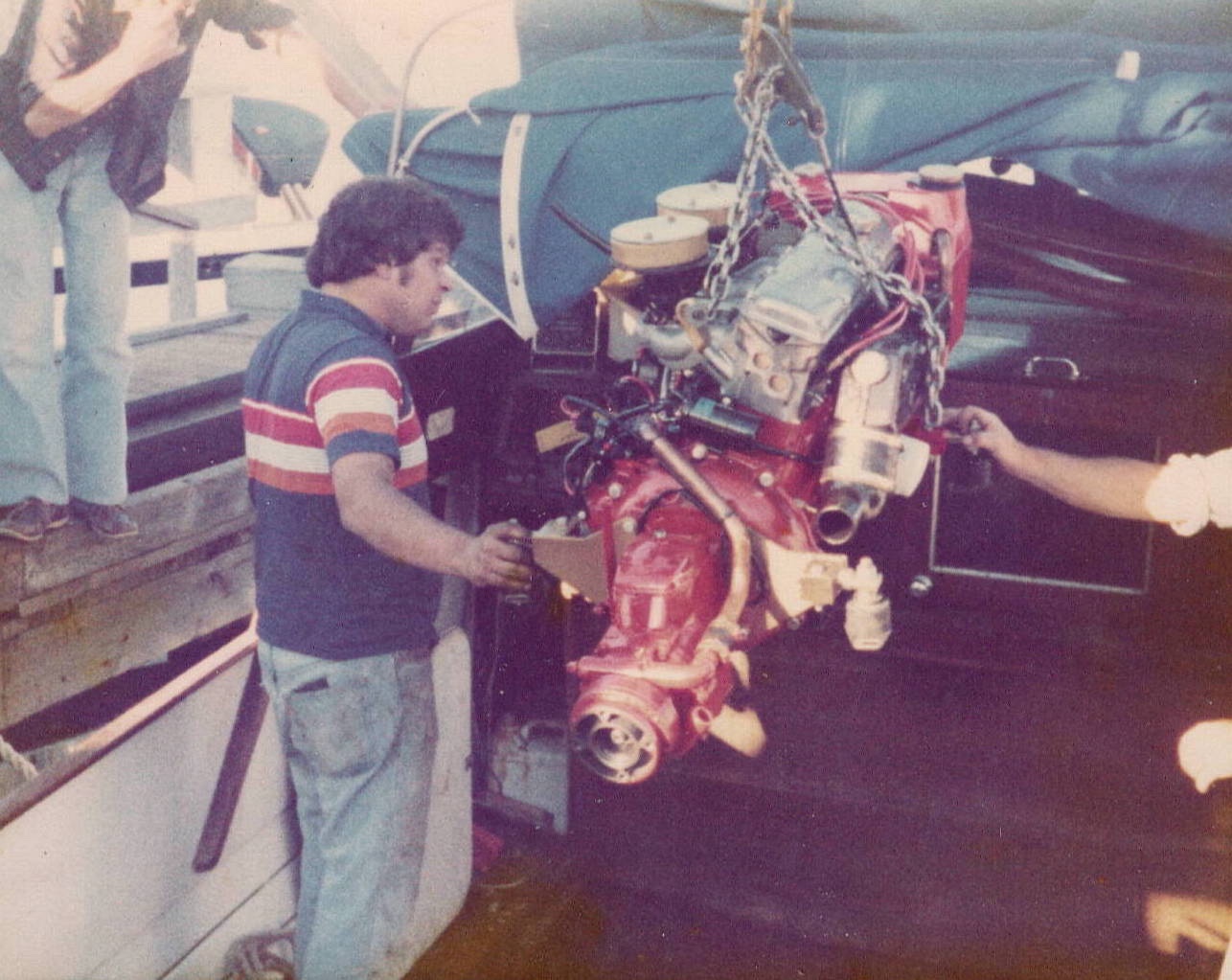
I’m not even sure what this was, but Gary understood it.
Gary always answered my car and computer questions (which also gave me an excuse to check in with him) and even helped me buy a car from across the country. As the years went by and the recession threw bumps and craters in his employment path, he discovered a talent and love for cooking.
Gary passed away Feb. 25, 2021 at age 70 in California.
While trying to think through ways to celebrate my brother’s life during a pandemic, I kept going back to his high school days. Would a vocational program have kept him in school? Probably. I can’t know for sure, but I do know the folks who work on our cars deserve good training in everything from basic engine function to the intricacies of today’s vehicles. As a supervisor, Gary would no doubt have appreciated new mechanics who came well prepared to diagnose and repair.
Therefore, I invite anyone who would like to do so to contribute to the automotive services program at the J. Everett Light Career Center at North Central to help today’s car whisperers get started. Just follow the link to the online giving form, select the “in memory of” option, and type in Gary Crowe under additional gift information. The very kind folks there will get it to the right place.
When Fred Rogers was about halfway through his studies at Pittsburgh Theological Seminary, the faculty asked him what sort of ministry he envisioned. Rogers, who was already doing children’s television work, said he hoped to make that a ministry.
“Nothing like that had ever been fashioned from Presbyterian fabric,” relates Maxwell King in The Good Neighbor: The Life and Work of Fred Rogers (Abrams Press, 2018), “and Fred’s teachers were somewhat at a loss to guide him.”
Fortunately, one of them suggested Rogers also study child development with Dr. Margaret McFarland at Pittsburgh’s Arsenal Family & Children’s Center, which he did. He and McFarland would work together for the rest of their lives. Rogers also took graduate-level child development courses at the University of Pittsburgh.
But Pittsburgh Presbytery’s elders felt Rogers should become an assistant pastor, then senior pastor of a church, and stand up in a black robe and preach on Sundays. They refused to ordain him.
A friend from seminary, the Rev. Bill Barker, risked his own position to advocate for Rogers’ non-traditional ministry. Rogers’ television audience — kids from about 2 to 8 — was a congregation of thousands if not millions, he said at a presbytery meeting. “‘And this is a man who has been authentically called by the Lord as much as any of you guys sitting out there,'” Barker recalled telling those gathered.
The elders somewhat reluctantly relented, and Rogers was ordained in 1963.
A few years later, Mister Rogers’ Neighborhood popped up on the television landscape. The show contained no Bible verses, prayers, or mention of God. It was just this quiet, sensitive guy and his neighborhood of people, puppets, and stories. Yet the core messages of kindness, courage, and respect for self and others could not have been clearer.
As a young child, I watched “Mister Rogers’ Neighborhood” when it first aired (in black and white) on a bulky Magnavox that was more furniture than appliance. His approach spoke to a kid who didn’t like a lot of noise and flash, but appreciated a reasoned, encouraging word. The fact that Mister Rogers was also a Presbyterian minister didn’t really surprise me. I figured he was where God wanted him to be. Rogers just had that vibe of someone who pointed the way to a bigger, better reality.
There are many more layers to this comprehensive biography by King, a journalist and now CEO of the Pittsburgh Foundation. What struck me was the way Rogers, with God and the people who entered his orbit, co-created a ministry. And he did so despite the church not knowing quite what to do with him.
Rogers probably would have continued with his television ministry with or without the presbytery’s endorsement via ordination. The fact that he persisted, a friend backed him up, and the church body changed its position testifies to our ability to learn even when we don’t especially want to.
Answering a call to serve God doesn’t always take the form we expect, and sometimes the best career move is to drop our expectations and listen.
As a practicing animal communicator who is also a longtime skeptical journalist, I understand the questions about whether animal communication is legitimate. To believe we can communicate telepathically with animals can be a stretch. To believe it can happen at a distance, without benefit of phone or WiFi, is even more challenging.
In an age of science, and when we have to be careful who we trust, is this not appropriate? I say it’s very appropriate.
So why would anyone even consider that communicating with animals is possible … or work with an animal communicator in order to help a pet?
It comes down to why we believe in anything: our lived experience, the credible evidence we see, and what we stand to gain.
This is me at age 9 with a friend’s collie, Lassie; and a tiger kitten who’d happened by that morning. I called her Mugsy. Though I don’t remember specifics, I know I talked with both of them. Mugsy followed me around for the rest of the day.
Experience: Been there, done that
As a young person, I spent a lot of energy hiding — or shutting down — my sensitivity. I did so in order to survive bullying and generally function in the world. I still communicated with animals, but knew better than to call it that.
Like most journalists of my generation, I learned to seek reliable sources and verify everything. “If your mother says she loves you, check it out,” was the motto. I prided myself on getting the facts right, spelled correctly, and presented with perfect grammar and Associated Press style. (I still do.)
When I was about 40, my cat Idgie developed inflammatory bowel disease, hyperthyroidism, and crippling anxiety. She received good veterinary care, but at the same time, my intuition was beginning to open back up. I knew there had to be more I could do.
There were “pet psychics” on TV, but I never thought much about them. Then I heard about someone here in Fort Wayne, Indiana who did intuitive work with animals — an animal communicator, she was called. Almost before I knew what was happening, I’d emailed her about my cat and signed up for the next class.
We learned. We practiced sending and receiving information telepathically with one another. Each of us then did a distant communication with an animal whose species, age, and gender we were told, with a specific question to be addressed.
I was stunned at the accuracy of the information I received. Holy crap, I knew this was real, but now it was tried-and-tested-real.
My cat and I began some tentative, yet heartening talks about trust, needed changes, and giving ourselves a chance. Her physical challenges continued, but there was a profound shift in the way we both viewed them. She felt heard in a new way, and we were able to move forward with more faith and less fear.
I moved through the intermediate and advanced animal communication classes over the next couple of years. We brought in photos and communicated with one another’s animal companions. We did an in-person communication with a dog our instructor brought in. Afterward, on my own, I practiced connecting with other animals.
This discipline is much more “practice” than “woo,” I discovered. I had this natural ability, but I had to use and develop it in order to truly help animals and their people. Which, I increasingly realized, was something I very much wanted to do.
Evidence: Tell me something good
Most of my clients are referred by others who have worked with me and found it helpful. Credible word of mouth beats Yelp any day.
Show me the science on animal communication, you say? Here are a few relatively recent scientific studies indicating there’s more to interspecies communication than previously thought. As always, judge for yourself. Also recognize that we may be just scratching the surface in this field.
• Dogs understand what we say and how we say it, Hungarian scientists found. They trained a group of family dogs to enter an MRI machine and scanned the way their brains responded to not only words but their tone.
• Two books reviewed in the Christian Science Monitor further delve into research on how attuned our canine companions are to our emotions, speech, and behavior.
• Cats react to the sound of their names, according to a group of Japanese scientists.
• Goats prefer positive human facial expressions, says a UK-based study.
• Not to be outdone, 23 horses were taught by Norwegian researchers to express their needs using symbol boards.
Benefit: What use is this?
In a training session at one of the newspapers where I worked, the presenter said the WGASA principle must be considered in every story we write or publish. WGASA stands for (and I am paraphrasing here): Who gives a shilling, anyway? In other words, the information we gather and present has to be relevant and useful to our readers.
It’s the same with animal communication; what are the benefits to animals and the people who love them? Maybe your animal friend has a seemingly intractable behavior problem, or you are facing a gut-wrenching end-of-life decision. An animal communicator should, at the very least, provide a compassionate “second set of eyes” on the issue.
Moreover, if you’ve chosen a reputable animal communicator whose approach resonates with you, chances are good you’ll gain something useful. It might be a tip you can act on immediately, such as moving the litter box or taking five minutes after dinner every night to toss a tennis ball for your dog. Working with an animal communicator can also yield insights about whether your dog feels a proposed surgery would help, or why your cat doesn’t like your new gentleman caller.
All of these things help you to have a better understanding of your animal friend, and vice versa. The result is less frustration and anxiety, and more peace of mind for all.
Is talking with animals too much to believe? You decide.

 When Fred Rogers was about halfway through his studies at

 All Creatures