There is such beauty in our animal friends. You know that already. Many, if not most, of the animals I’ve been blessed to work with this year in my animal communication and Let Animals Lead meditation practice appear in this short video.
In 2024, Indiana experienced some amazing beauty in the sky as well — the solar eclipse in April and at least a couple of Northern Lights displays. A few photos from these are included as well.
Thank you to Camp Red Cedar for the cover image of the aurora borealis above the camp grounds; Chandu Prem Lal for the stunning capture of the eclipse behind the Indiana Soldiers and Sailors Monument; Heather Hoffmann for her beautiful scenes of the Northern Lights; Jenn Andrew for her photo of me at the pasture fence and everyone else who sent their best.
Even bigger thanks go to all of you who trusted me to listen to and hold space with the horses, dogs, cats, goats and other creatures in your lives. I look forward to doing even more in 2025.
Want a better connection with your dog, cat, horse or other companion? This newly revised, mobile-friendly guide can get you started.
As an animal communicator and professional writer, I know how important it is to be succinct. That’s why I streamlined the earlier version to make it even easier to begin to find the answers you seek.
Visit my website and sign up for the monthly “All Creatures” newsletter – on the left or at the bottom, depending on how it displays on your device. You’ll get an email with a link to download it.
Please be assured that 1) I won’t share your info; 2) you’ll only get monthly-ish emails from me and 3) I don’t know how to spam.
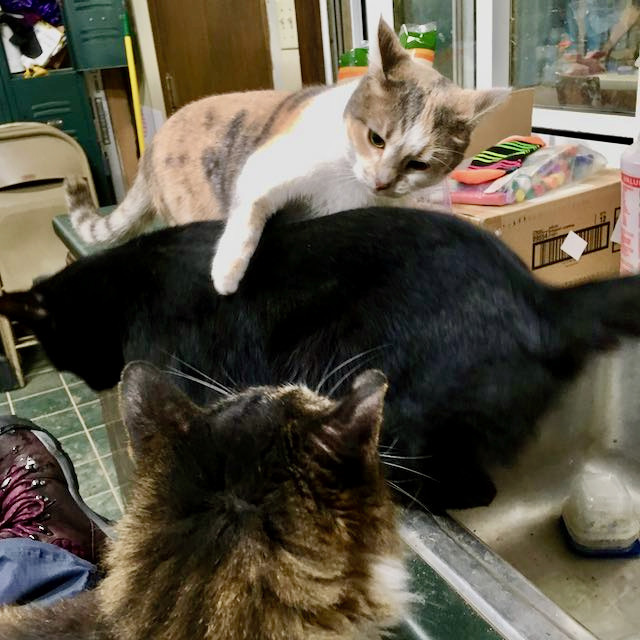
That’s what I told the three cats, thinking they wouldn’t believe me. But they worked out the logistics themselves. The tabby stayed put in my lap, the black cat sat on my shins and the calico decided it was more fun to sit on the counter and swat at everyone else. We all settled in for the meditation session … just as it was, which is what the Let Animals Lead® method is about anyway.
Of course there’s enough healing energy to go around, just as there’s enough love to go around. In a world of finite space, allotted time and the ways different species regard resources, we can still be fair. The animals, in fact, might be able to work it out themselves and teach us. Here’s what I’ve learned in my animal communication and Let Animals Lead® meditation practice … and in my own home.
When someone sticks their neck out, pay attention.
There is generally a pecking order among horses. If I want to let a herd know about a change or event, I’ll speak to all of them — but ask, say, the lead mare to help the others remain calm. That respects the horses and helps them all feel safer.
I’ve also learned that if a horse comes to the fence or sticks his head out of a stall, I need to see him first because there’s probably a reason. For example: Mojo the Tennessee Walker, above, very often walked to the fence when I arrived. His “Hey, over here! Me first!” was never subtle.
One day Mojo turned around, pressed his backside to the fence and asked for hands-on energy. After about 20 minutes he walked off, seeming a bit relieved, but I had picked up on some pain on the left side. The equine chiropractor saw him shortly thereafter and sent me a diagram of his misalignment. No wonder he was hurting. Another time he needed a kind word because his buddy left his side (and because he did not get chosen) for a special ride with a delightful eighty-something lady.
They might know who needs help first.
Animals can be astute, too, about who might need help more than they do at the moment. Two mini horses (one of whom was disabled), were hanging with a mustang who’d been battling a persistent infection. When the three of them approached me, the two minis hung back. I thanked them, worked with their mustang buddy, and made sure to see those kind minis before I left that day.
A cow at an animal sanctuary where I trained had adopted two young calves as her own. When I approached their stall and offered to share a healing meditation, the cow turned her head toward the two calves. Anything I was offering should go to them first, she told me. I assured her that all of them were free to participate — but following her lead, I turned toward the youngsters. As the session continued, I felt mama cow join us as she figured out she wasn’t taking anything away from her young charges.
Don’t placate. Just toss the ball.
Dogs are famous for their “how could you?” look if they detect another dog’s scent on you. Or if you are brazen enough to pay attention to another dog right in front of them, you cad. Canine jealousy was even documented in a University of California study.
Imploring dogs not to be jealous and/or to wait their turn is not likely to make them feel any less wronged. (Trust me; I used to do both.) With animals, actions speak louder than words, and energy speaks even louder. If I come home with the scent of other dogs on me, I let my dogs sniff without comment. Then I make sure they get some one-on-one time — a belly rub or a couple of toy tosses mean more than you know.
When we build even a little more awareness and trust, “enough” can look like plenty.




 All Creatures