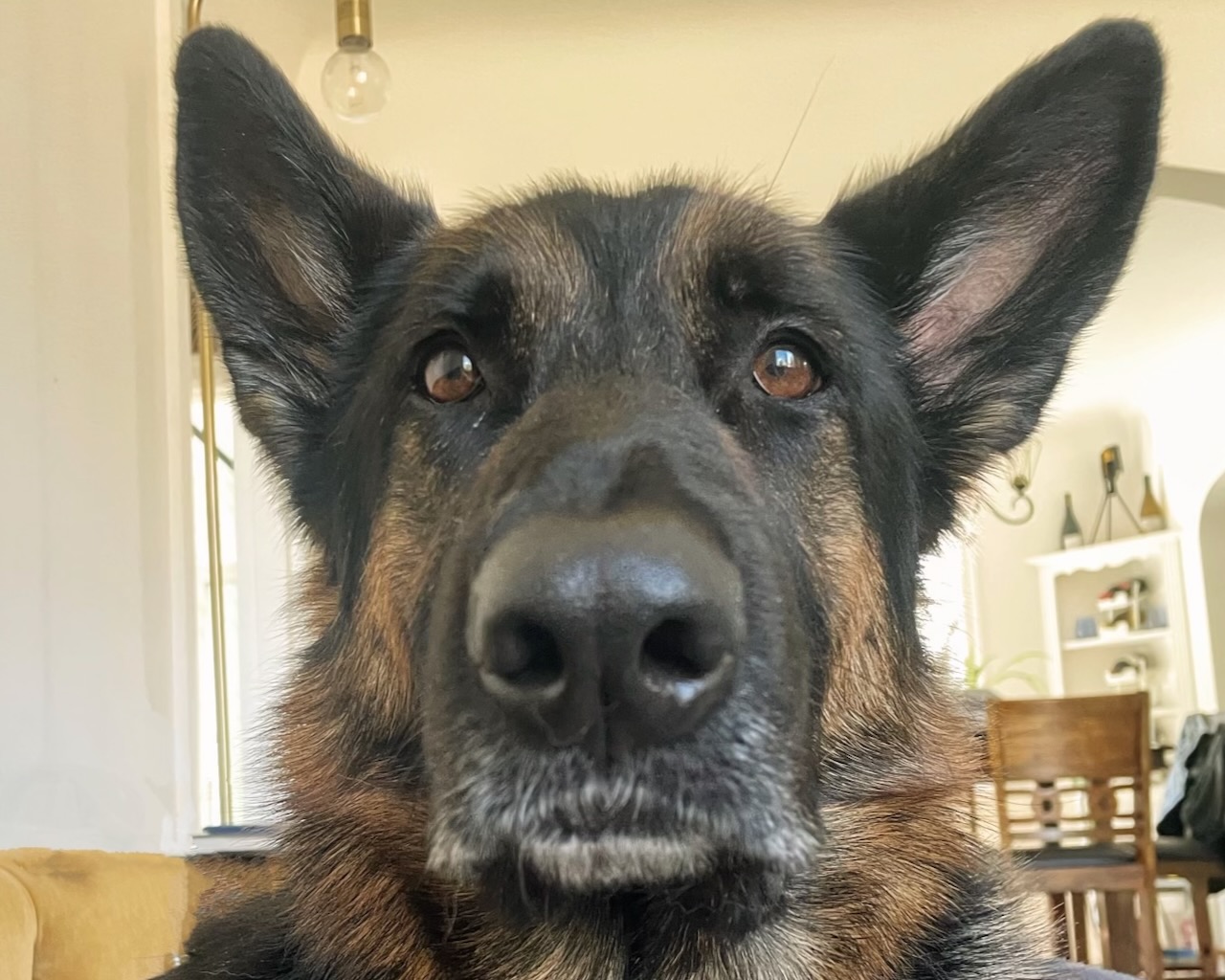
As the July 4 fireworks intensified, Iona the German shepherd trotted from one window to another — an elevated version of what her mom calls (and I paraphrase) guard dog stuff.
By the time night fell, a calming chew had taken the edge off, but she was still distressed by the pops, bangs and booms she could hear and feel but not see. How was she supposed to respond to this threat with insufficient data?
I told Iona, as I’ve been telling animals for decades, that it’s just human noise. It’s rattling, to be sure, but manageable. Even though she couldn’t see the source of the noise, she was safe at home and we would ride it out together.
My partner, our honorary daughter, Iona and I settled in to watch a movie. Eventually, Iona curled up on the sofa (of course she’s allowed) with her mom, and a bit later she shifted around and stretched out with her head in my lap. I told her she was very brave even if she didn’t feel brave.
On the same night, a client of mine sat on the pasture fence as horses gathered around her. The humans on the nearest street seemed to have an endless supply of fireworks, and she stayed with the herd until the worst was over.
We are all confronted with “noise” that scares, confuses or angers us. We can’t control it, but we can manage its impact. One way is by acknowledging it and being present.
Even when we perceive the sound differently (say, like a dog and a human), we can sit quietly together and see if something better surfaces. Even if it’s just a kind word or an ear scratch.
Dolly, left, and Maggie after a Let Animals Lead® session.
You may hear me talking more about meditation than Reiki these days. That’s because the animal Reiki method I practice, Let Animals Lead®, works through meditation. It’s different from what you may know as Reiki.
Let Animals Lead® was developed by Kathleen Prasad, founder of Animal Reiki Source and co-founder of the nonprofit Shelter Animal Reiki Association, to which I belong. Let Animals Lead® is a specialized form of Reiki, a Japanese stress relief modality: “Rei” stands for spirit or higher power, and “ki” (sometimes seen as “chi”) is the energy that animates every living thing.
Reiki was developed a century ago by Mikao Usui. It was essentially meditation; subsequent teachers added hand positions. These hand positions are used with a human client seated in a chair or lying on a massage table. That was how Kathleen and tons of other practitioners, including me, learned Reiki. Today, Reiki promotes relaxation and healing in spas, private clinics, hospitals and other settings.
As time went on, Kathleen found that “people Reiki” wasn’t always effective with animals … despite the best intentions of the practitioner. Because animals are much more sensitive to energy, touch generally isn’t needed. Animals who have experienced abuse, trauma or illness may even shy away from touch.
Kathleen saw this most acutely when her beloved dog Dakota was sick. He wouldn’t sit still for traditional Reiki, but when she sat quietly in meditation, he settled beside her.
Creating a peaceful space where animals are free to share on their own terms turned out to be a game changer. Thus Let Animals Lead® was born.
I had taken one or two of Kathleen’s earlier classes and practiced animal Reiki, but training with her as a Let Animals Lead® practitioner and teacher allowed me to offer animals and their people something better. It is my honor to see creatures from mice to rescued draft horses join with me and take the lead in their own healing — whatever that means for them.
Is it still Reiki? Yes. Is it more accurately and recognizably described as meditation? Also yes.
In a world where so much seems murky, talking about a discipline that makes animals’ lives better can be clear.
Respect for animals and their people is the foundation of my work as an animal communicator and practitioner of Kathleen Prasad’s Let Animals Lead® animal Reiki meditation method. This means an animal is free, at any time, to choose not to communicate with me or participate in a meditation session. We can try again another day or I can issue a refund. Either way, the animal’s “no” is honored.
It also means that regardless of who pays, I must have permission of the animal’s owner for an animal communication or meditation session. By owner (or guardian) I mean the person who is legally responsible for the animal, whether that is an individual or an organization such as a shelter or rescue.
That permission is required is stated on my website, but it’s still come up a couple of times recently. So this is to let you know where I’m coming from and how you might handle potentially problematic situations.
Why permission is needed
Having permission from the person who is legally responsible for the animal:
Keeps everything above board, which naturally brings better outcomes for the animal communication or meditation session.
Protects the animal and respects the boundaries and relationships of all humans involved. (Put another way: Say you have a child, or an adult for whom you are legally responsible. Barring some kind of emergency, you would not want a friend or relative to arrange a counseling session or alternative treatment for that person without your permission. Anyone who tried to do so, however well intentioned, would probably lose your trust. You wouldn’t think much of the practitioner involved, either.)
There’s an animal you love and want to support with animal communication or meditation who isn’t technically yours. How do you handle that?
Here are some examples:
A rescued horse has been returned — again — to the sanctuary where you volunteer. The vet has ruled out injury or illness as a cause for his behavior issues. The director, barn supervisor, and other volunteers are all at a loss as to where or even whether to try to place him next. Asking the horse could yield information about the behavior and what kind of home he wants, and you are willing to pay for the session out of your own resources.
You are fostering a cat from your local animal shelter. The cat has been over-grooming to the extent that raw, bald patches are showing up on her legs and belly. The cat was thoroughly checked out by the shelter vet before coming to your home, and there is no medical cause. You know from experience that this is a common sign of stress, and the bald patches could put off prospective adopters. That is, if you don’t adopt this sweet kitty yourself. You’re happy to pay for a meditation session to help her feel more relaxed and secure.
Your sister is struggling with decisions regarding the care of her dog, who is severely ill. Her veterinarian has placed a couple of choices before her, and she is overwhelmed. You love this dog, too, and you’d do anything to help your sister. Should you just go ahead and book the session, see what the animal has to say, and then tell your sister?
In the above scenarios, I need the permission of the sanctuary director, the shelter director/adoption supervisor, and your sister, respectively. Talk with the animal’s owner, share a link to my website, and offer an animal communication session as a gift to support the animal — and them. They’re also welcome to contact me with questions. If the answer is yes, I am honored to help. If the answer is no, that is absolutely fine.
If you are interested in a meditation or communication session but are not sure about permission issues, contact me. Some situations are just confusing. I will do my best to help you sort it out and find the best way forward.
Giving animals a voice is a responsibility, and part of that responsibility is maintaining the trust and respecting the boundaries of the people and animals involved.
It lets us all speak, and more importantly listen, freely.




 All Creatures