Joining up with ‘The Man Who Listens to Horses’

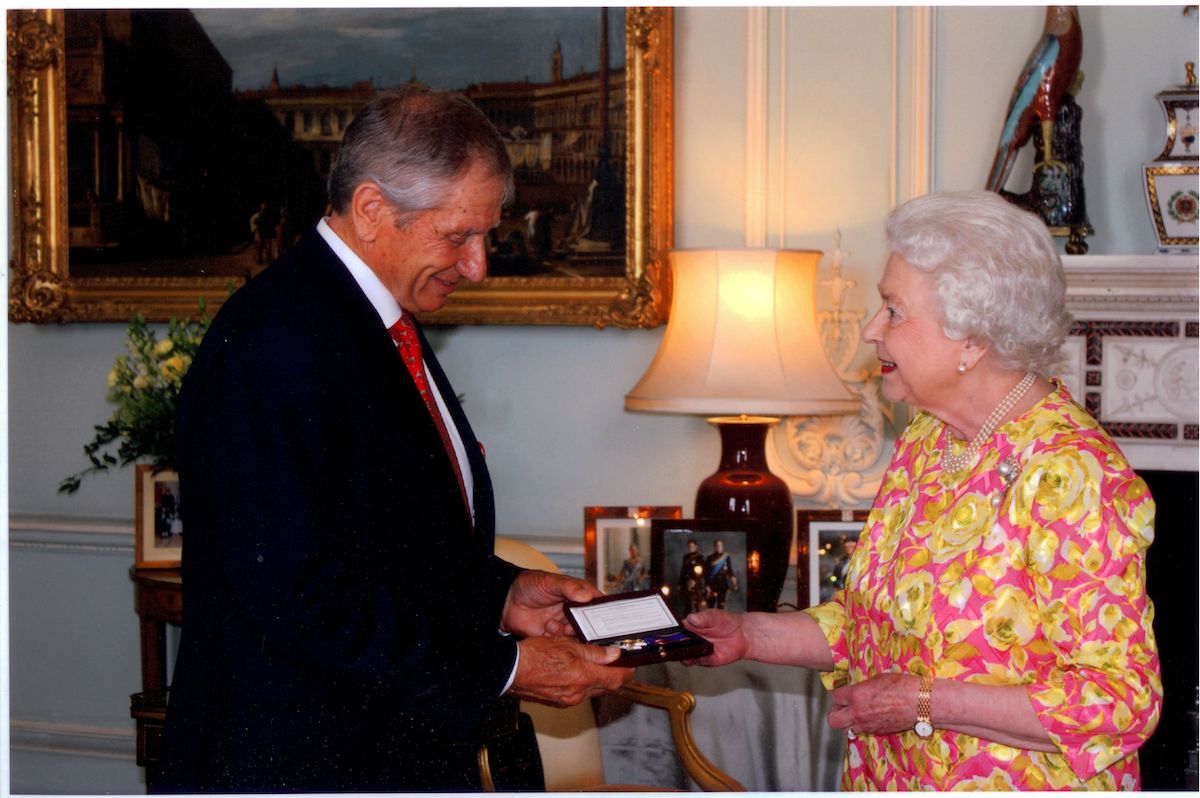
Monty Roberts, known for his nonviolent horse training methods, received the MVO (Member of the Royal Victorian Order) distinction from Queen Elizabeth II. (Photo courtesy Flag is Up Farms)

I love seeing the connections between my work and that of others in the horse world — in this case, trainer Monty Roberts.

Listening to horses (in their language) and building their trust propelled the career of this “California cowboy” and earned the trust of the late Queen Elizabeth II. After listening to Roberts’ Horsemanship Radio podcast for some time, I decided to read his 1996 autobiography, The Man Who Listens to Horses. Though I am not a horse handler, his Join Up® method of starting horses struck a familiar note. I wanted to know more.

Roberts, born in 1935, described a childhood of hard work and harder knocks. His father used traditional and often brutal methods to break horses in body and in spirit. Despite or perhaps because of this, young Monty figured out early that kindness and giving the horse a choice yielded better results.

His father and other horsemen called his methods foolish and dangerous, Roberts recalled. Dad drove home the point with abuse, prompting the younger Roberts to keep quiet about nonviolent horse training until he was out from under his father’s roof.

Word about Roberts’ work eventually got out. In particular, it got into a horse magazine read by Queen Elizabeth II, who invited Roberts to England to demonstrate Join-Up®. The trip was a game changer, not only for Roberts and the monarch who would become a friend, but for a growing number of horses around the world.

Join-Up® uses the natural language of the flight animal to gain the horse’s trust. The aim is for the horse to accept — by his own choice, never force — saddle, bridle and rider.

To my mind, this puts Join-Up® in the same family as Kathleen Prasad’s Let Animals Lead® meditation method, which I practice. It’s all about animal agency. Ditto for Fear Free, in which I’m also certified, which teaches techniques trainers, veterinarians, shelter workers, groomers and pet owners can use to reduce animals’ fear, anxiety and stress.

Likewise, though the book describes Roberts as a real-life horse whisperer, he claims no mystical ability. I agree that communicating with animals isn’t some mysterious mystical thing or the human telling the horse what to do so that the horse understands and complies. It’s about learning how horses experience the world, listening without expectation and respecting the inherent worth of another being.

So many descriptions of horse work in this book, including the step by step Join-Up® guide in the appendix, left me wanting a visual — so here’s a video of Roberts demonstrating with a young horse. Roberts explains what he and the horse are doing at every turn, though the image quality isn’t the best.

Also check out this one of Roberts and British actor Martin Clunes (“Doc Martin”) working with one of Clunes’ beloved Clydesdales.

A few parts of the book about Roberts’ business dealings read like something out of film noir. The depiction of his police officer father killing a black suspect, which he admits family members asked him not to include, is very difficult to read. The introduction and afterword, both by author Lawrence Scanlan, could have been pruned too.

I also found myself wondering why nonviolent horse training (or nonviolent interaction in general), was such a hard sell … but obviously, it was and in many arenas still is.

Whatever your background or philosophy, if you have or work with horses in any capacity, learning more about Monty Roberts’ method is worthwhile.

Permission is key in animal communication, meditation

Photo by Unlaw on Pixabay

Respect for animals and their people is the foundation of my work as an animal communicator and practitioner of Kathleen Prasad’s Let Animals Lead® animal Reiki meditation method. This means an animal is free, at any time, to choose not to communicate with me or participate in a meditation session. We can try again another day or I can issue a refund. Either way, the animal’s “no” is honored.

It also means that regardless of who pays, I must have permission of the animal’s owner for an animal communication or meditation session. By owner (or guardian) I mean the person who is legally responsible for the animal, whether that is an individual or an organization such as a shelter or rescue.

That permission is required is stated on my website, but it’s still come up a couple of times recently. So this is to let you know where I’m coming from and how you might handle potentially problematic situations.

Why permission is needed

Having permission from the person who is legally responsible for the animal:

  • Keeps everything above board, which naturally brings better outcomes for the animal communication or meditation session.
  • Protects the animal and respects the boundaries and relationships of all humans involved. (Put another way: Say you have a child, or an adult for whom you are legally responsible. Barring some kind of emergency, you would not want a friend or relative to arrange a counseling session or alternative treatment for that person without your permission. Anyone who tried to do so, however well intentioned, would probably lose your trust. You wouldn’t think much of the practitioner involved, either.)
  • Is in keeping with the codes of ethics I follow for animal communicators and Let Animals Lead® practitioners.

But what if …

There’s an animal you love and want to support with animal communication or meditation who isn’t technically yours. How do you handle that?

Here are some examples:

  • A rescued horse has been returned — again — to the sanctuary where you volunteer. The vet has ruled out injury or illness as a cause for his behavior issues. The director, barn supervisor, and other volunteers are all at a loss as to where or even whether to try to place him next. Asking the horse could yield information about the behavior and what kind of home he wants, and you are willing to pay for the session out of your own resources.
  • You are fostering a cat from your local animal shelter. The cat has been over-grooming to the extent that raw, bald patches are showing up on her legs and belly. The cat was thoroughly checked out by the shelter vet before coming to your home, and there is no medical cause. You know from experience that this is a common sign of stress, and the bald patches could put off prospective adopters. That is, if you don’t adopt this sweet kitty yourself. You’re happy to pay for a meditation session to help her feel more relaxed and secure.
  • Your sister is struggling with decisions regarding the care of her dog, who is severely ill. Her veterinarian has placed a couple of choices before her, and she is overwhelmed. You love this dog, too, and you’d do anything to help your sister. Should you just go ahead and book the session, see what the animal has to say, and then tell your sister?

In the above scenarios, I need the permission of the sanctuary director, the shelter director/adoption supervisor, and your sister, respectively. Talk with the animal’s owner, share a link to my website, and offer an animal communication session as a gift to support the animal — and them. They’re also welcome to contact me with questions. If the answer is yes, I am honored to help. If the answer is no, that is absolutely fine.

If you are interested in a meditation or communication session but are not sure about permission issues, contact me. Some situations are just confusing. I will do my best to help you sort it out and find the best way forward.

Giving animals a voice is a responsibility, and part of that responsibility is maintaining the trust and respecting the boundaries of the people and animals involved.

It lets us all speak, and more importantly listen, freely.

Dealing responsibly with anger helps animals, too

In animal communication sessions, an animal will often show me an angry person in a current or past household.

It could be an abuser. It could be a situation that led to a person or animal living in fear, getting hurt or neglected, or losing their home. Maybe all of these.

It could also be someone who would never harm an animal or person, but is struggling with human stuff. Animals are naturally wary of angry people, though many wish they could help with whatever the problem is. Animals don’t understand the specifics, but they get the threat. Their humans mean the world to them.

What if we could harness our anger to recognize and solve problems rather than create more problems?

An essay I read in seminary, “The Power of Anger in the Work of Love” (in Making the Connections: Essays in Feminist Social Ethics) made me think that might be possible. Theologian Beverly Wildung Harrison said anger is “better understood as a feeling-signal that all is not well in our relation to other persons or groups or to the world around us.” Though anger doesn’t automatically lead to wise or humane action, she added, it can help get us there.

That is, if we calm the heck down first and think it through (my addition).

Can we learn to deal with our anger without being jerks … or worse? Sometimes a pause of even a few seconds can buy life-changing time to respond rather than react. We may not be able to change the situation, but we can change the energy we send out. It matters, I promise.

Using anger constructively might seem too good to be true in an age of pointing fingers and putting up walls. However, check out this excellent Kiwanis Magazine story by my friend Julie Saetre. It dives more deeply into why people are so angry these days and coping in a way that might actually help.

Also, please support those who work tirelessly (and often thanklessly) to help animals affected by abuse and neglect. Increasingly, domestic violence shelters are teaming up with humane societies so that people in abusive relationships can get themselves and their pets out of harm’s way.

We all owe it to the animals, one another and ourselves to do better.