Remaining a trainable human

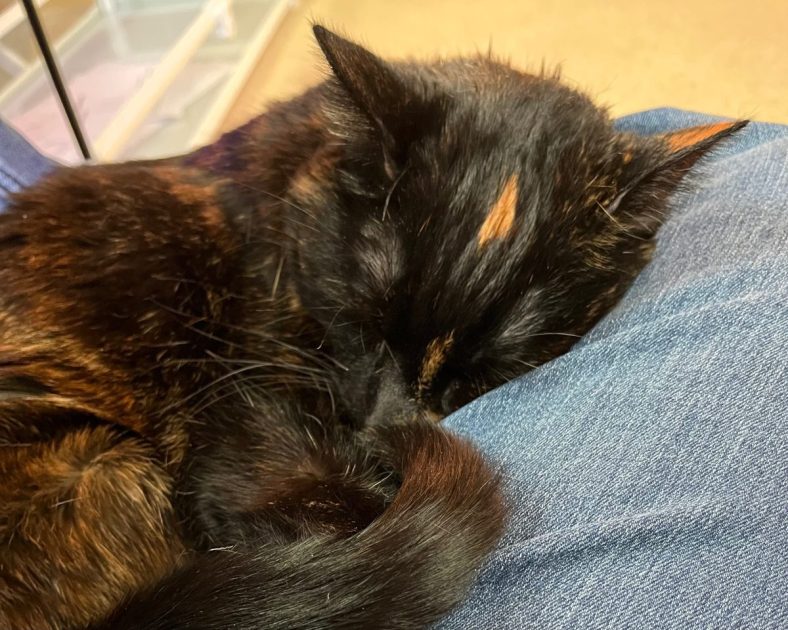
Photo by Nancy Crowe

The monthly application of flea/tick/heartworm preventive to the back of our cats’ necks is one of their least favorite things. It’s one of those tough tasks I counsel my animal communication clients to approach with calm, firm deliberation. Respectful handling is key to Fear Free for vet clinics, shelters, groomers and more.

Yet sometimes we fail to follow through on what we know. A couple of months ago, for reasons I don’t even remember, I was in a hurry. With applicator in hand, I quickly went to Lucy, bent over her and dripped the liquid onto the back of her neck. She shot me a look of reproach — and worse, hurt — and ran off.

I instantly regretted how I had administered the medication. There was no rough handling, but my “We’re getting this done. Now.” approach didn’t ease the process for Lucy or bolster her trust in me. My disappointment at having ignored my own advice, training and experience was secondary.

Nevertheless, Lucy accepted the treats I offered immediately afterward, along with an apology.

Later that day, when the stress of the moment had had a chance to wear off a bit, I invited her to join my yoga practice, something we both enjoy. For the most part she offers a classically feline “you call that a stretch?” glance and settles on a nearby chair. On this day, when she padded into the room, I told Lucy I knew better and would do better. She joined me on the yoga mat and purred.

When the time came for the next month’s dose, I took a second to remember what I knew. That’s obvious, yet so easy not to do.

I carefully approached Lucy, picked her up and held her for a moment. “I know you don’t like this, but we can manage,” I said, keeping my breathing even. I set her down on her cat tree where I could steady her without having to bend over her. I took another breath, squeezed on the topical medication and gently set her on the floor. Again she hurried off, stopping only briefly for treats.

I moved on to the day’s next task, assembling a glass terrarium to keep our other cat from nibbling on the smaller houseplants (a story for another day). I sat cross-legged on the floor with the base, sides, doors and instructions spread out, along with the enclosed bag of bolts and other itty bitty parts.

Within a few minutes, in strolled Lucy. She sniffed at the new materials on the floor, then climbed into my lap and curled up, purring.

Cats like trainable humans.

Veterinarian finds hope, healing on streets

Photo by Mart Production/Pexels

As the lead vet at a last-stop California animal shelter, Dr. Kwane Stewart dealt with waves of intakes and discouragement. It got to him.

That’s not uncommon among people who work with animals: You go in knowing you can’t save them all (though of course you want to). Then human stuff piles up … irresponsible pet ownership, abuse, neglect, bureaucracy, you name it — and you wonder if you can do anything at all.

Stewart began to stop and talk with the area’s homeless people who had pets, offering his services pro bono. Despite the initial mistrust — how did they know he wasn’t going to take their dogs or cats away? — he found renewed purpose. He details this journey in What it Takes to Save a Life: A Veterinarian’s Quest for Healing and Hope.

“Homeless people are loving, dedicated pet owners — which I hadn’t thought the case before I started my work,” he writes.

Another surprise was how well behaved the dogs were. In clinics, he’d seen his share of out-of-hand dogs whose humans insisted they had no time to train them. The dogs of the homeless did not pull at their leashes, bark or growl when Stewart approached, nor did they attack other dogs. These owners had nothing but time. They and their canine companions could read each other perfectly.

Stewart has also been inspired by those who weren’t homeless, but still pretty beaten down by the circumstances of their lives. One of these was Richard, a Vietnam veteran who lived in a trailer with his wife and several rescued animals. When Richard’s dog Courtney, a Corgi-hound mix, required a $3,000 surgery for bladder stones. Richard quickly agreed. Stewart asked if he was sure.

“Do what you’ve got to do. Period. … Courtney’s a member of the family. I ain’t rich now but I’ve been poor and I can and will be poor again if that’s what it takes. … That’s just something that when you become a responsible pet owner, that’s what you’ve got to do.”

Stewart put some info about Richard and Courtney on a GoFundMe page. He was stunned when $17,000 came in within a week. In what he calls one of his favorite details of all time, one of the donors was another pet owner he’d helped.

Another great detail: Stewart also works on TV and movie sets, making sure animal actors are safe and well. He overheard Brad Pitt bragging about how sweet, loyal and intuitive his own dog was. “If I closed my eyes, I could have been on Skid Row, listening to someone on the streets talking about what their dog meant to them.”

There is, of course, much more to this memoir. Stewart’s own history includes being bullied as a child, getting into fights well into adulthood, mental illness, a broken marriage, finding joy in fatherhood and navigating vet med as a Black man.

Stewart now leads the Project Street Vet nonprofit, which currently has teams in California, Florida and Atlanta.

‘Am I making my animal sick?’

Image by Mirko Sajkov from Pixabay

You’re in the thick of a stressful time, and now your animal friend is sick or has developed a puzzling behavioral issue. That’s hard enough.

Since the link between illness and stress cannot be denied — nor can the link between you and your animal — you may even wonder if you are part of the problem. Did the animal take on your stress? Were you so distracted that you didn’t notice your pet was having problems?

“Am I making my animal sick?” is a question I’ve heard from friends and my animal communication clients. I’ve heard it from myself, too.

Before you go down this rabbit hole (I’ve been there; would not recommend), remember that the first person to talk to is a licensed veterinarian. Take the opportunity to learn and make recommended changes in your pet’s diet, environment or routine.

For that matter, this could also be a great time to top up your own coping skills. Exercise, for example — more dog walks, barn time, or cat play sessions — could benefit both of you.

Benefiting both of you is what this is about.

When I’m communicating with an animal, he or she will often show me stress in the household or barn. That can come through in, say, the image of a person angry or downcast. It could also be the sound of raised voices or just a heaviness I can feel in my chest.

Animals may not understand what’s going on, but they feel it. Some animals are afraid, perhaps for good reason. Most want to help.

Bentley, a 12-year-old Westie mix, developed digestive issues just as his person, Aileen, was grieving a huge loss. The vet prescribed medication and a change in diet. Still, she wondered if her stress had exacerbated his condition. “Am I driving him nuts?” she asked.

That notion hadn’t occurred to Bentley, who showed me a grey fog surrounding Aileen and her heart intact. “We’re doing this together,” he told me. They both have continued to heal.

It reminded me of when I feared I was making my tiger cat, Idgie, sick. I took her to the vet, we began treatment for her hypothyroidism and I took some important steps to heal myself and my life. On the night before her thyroid surgery, instead of the usual worrying I sat down to at least try a meditation. She curled up in my lap and purred. “OK, I think you’re starting to get it,” I heard before she drifted off to sleep. She inspired me to take better care of myself as well as her, and we enjoyed several more years together.

I’ve never had an animal tell me their person’s distress made them ill. What they tell me instead is that they and their beloved humans are tackling stress, illness and whatever else as a team. They can’t solve your problems (though your shepherd dog would gladly try), but they will sit, stand and walk with you every step of the way. That may be the best medicine of all.