Do you hear what I hear?

As a city child connecting with nature, animals, and the bigger picture of Christmas, “Do You Hear What I Hear?” became a favorite. The story behind the song, which I learned only recently, deepens its meaning for me.

But first, the story in the song: The night wind speaks to a little lamb of a brilliant star. The lamb tells a shepherd boy of music high above the trees. The shepherd boy tells a king about a child shivering in the cold of a humble stable and worthy of riches. The king tells the people this child is the bearer of goodness and light … and exhorts all to pray for peace.

Each being tells another about what they see, hear, and know. They’re all experiencing a different aspect of what is happening. None of them are wrong.

“Do You Hear What I Hear?” was written during the Cuban Missile Crisis by an American husband-and-wife team. According to this Franciscan Media account, French-born lyricist Noel Regney endured horrible trauma during World War II after being drafted to fight for the Nazis. The threat of catastrophic war in 1962 brought it all back as he faced the task of writing a Christmas song for a record producer.

Then Regney saw two babies in strollers smile at each other on a New York street. Their innocence reminded him of lambs … and there was the beginning of the song. At home, he wrote down the lyrics and asked his then-wife, pianist and composer Gloria Shayne, to write the music. Neither could get through the song without crying, Shayne recalled later.

That was the light they found and shared during during a dark time. We can share our light, too — through a smile, a prayer, a gentle pet, an ear scratch, a bag of food to an animal shelter or rescue. It doesn’t matter how small, stupid, or pointless we might think it is. That bag of food might help a lonely veteran keep his dog. Your smile at the woman at the grocery store may be the only kindness she experiences that day. That prayer may turn on a light for you.

“Pray for peace, people everywhere,” indeed.

Bing Crosby’s 1963 rendition of “Do You Hear What I Hear?” is probably the best known. I grew up with the Andy Williams version from the 1966 Great Songs of Christmas album. For this tribute to the animals I’ve worked with this year in my animal communication and animal Reiki practice — and their wonderful people — I chose Mannheim Steamroller’s instrumental version.

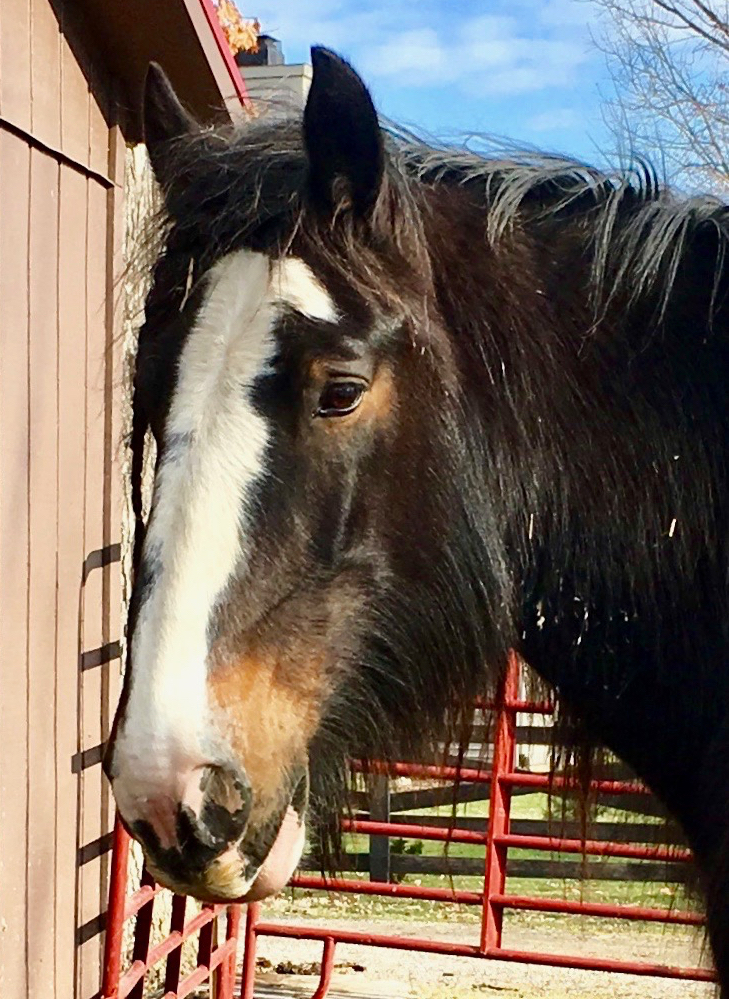
Just like the little lamb, the animals of our time tell brilliant stories of hope. I’ve heard a cat’s deep love for her person as she is ready to cross, a draft horse’s amazement at being able to choose, a deaf and blind duck giving life a chance, and more. For each one, I am grateful.

(Photo by Allison Wheaton)

The naming of horses

2019 08.14 Dolly 3 - edited

I caught Dolly in the middle of lunch with hay on her face, but her star quality shines through.

There are many rules for naming racehorses, but none for your average equine citizen. From what I’ve observed, horses often get new names when they get new people, new homes, new jobs, a second chance, or any combination of these. Some retired racehorses, like my friends Beau and Pirate, go by shorter versions of their racing names.

This isn’t unique to horses. Look at the way we humans take on and drop nicknames, take spouses’ names, reclaim family names, hyphenate, and depending on who’s talking, go by names like Mom.

One horse I know chose a name his new person wouldn’t have picked in a million years. Another came by hers through blonde star synchronicity. Yet another, when given the choice, kept the name she had.

Duke

I felt the sadness of the 17-year-old shire as soon as Allison Wheaton, director of Summit Equestrian Center, sent me his photo. After years as an Amish farm horse, and apparently not the best of situations, he was to become Summit’s newest resident late last year.

Duke 04.05.19 v

This is Duke a few months after his arrival at Summit Equestrian Center. He still wasn’t out with the herd, but he’d decided he liked Reiki. (Photo by Nancy Crowe)

Allison asked me to communicate with him before he arrived and find out what he needed in the transition, and what he might like to do. And would he like a new name, or would he prefer to keep the one he had (Angmar)?

The notion that he had a choice about anything was a strange concept to this heavy-hearted soul. Yet when I asked him what he wanted to be called, I heard: “Just call me Duke.”

I passed that along. Since most school/sports rivalries are not on my radar, it didn’t occur to me that Allison, a University of North Carolina grad, might wince at the name of her alma mater’s chief rival. As I learned later, she had vowed never to name a dog, horse, or anything else Duke. But Duke it was.

As fall deepened into winter, Duke acclimated and found his footing as a therapy horse. He found he appreciated being listened to and liked Reiki, especially once he realized it was his choice. Getting him to the point where he could join the rest of the horses in the pasture took months, many introductions, and a few scuffles.

Then one day this spring, Duke caught my eye from across the pasture. He was standing up straight, ears forward, with the rest of the crew.

“Do you see where I am? Do. You. See. Where. I. Am?” I heard.

Yes, Duke … I see you.

Dolly

Malibu, a Tennessee Walker-Belgian cross, had a few different homes by the time she joined the Summit herd. No one seemed to have time for her, and now she had no idea where she belonged.

Three or four days later, “Hello, Dolly!” — from the musical of the same name — got stuck in my head. I listened to the album over and over as a child and saw Carol Channing in what many consider her signature role as Dolly. But I hadn’t heard it recently or thought of it much.

The day after that, I received a text from Allison that the newcomer had settled in a bit, but Malibu didn’t seem like the right name. “Dolly? There’s got to be a sassy blonde star name that fits better,” she said.

I told her about the musical and sent a video link to the song. It includes the lyric “Tomorrow will be brighter than the good old days.”

Allison was thinking of Dolly Parton and I was thinking of the fictional Dolly Levi — but both seemed to fit. So Dolly it was, and she’s already shed stardust on a couple of participants in Summit’s veterans program.

Lulu

Some horses keep their names. Lulu, a beautiful paint mare, was rescued from a horrible neglect situation. As Lulu began a new chapter at Summit, Allison asked me to see if she wanted a new name as well … like Cheyenne?

2019 07.26 Lulu & my hand copy

Lulu has been learning to trust again.

When I asked Lulu, she told me she knew who she was and it didn’t matter what the humans called her. Cheyenne was fine, but she was also fine with sticking with Lulu, so that’s what we did.

Recovery is all about ups and downs, and less than two years later, Lulu’s is no exception. She has a good buddy in Pirate, one of the aforementioned retired racehorses, and she’s helped some of Summit’s human clients heal their own wounds. Every time I check in with her, even if she is struggling with the effects of her past, I see her choose to give her new life — still as Lulu — a chance.

You tell me …

How did your horse friends get their names … or new names?

CBD for pets? Five things to consider

A number of pet owners tout the benefits of CBD (cannabidiol) oil for joint pain, anxiety, and even epilepsy. Some say it’s the only thing that helped after other treatments failed. 

dog-160561_1280 copy

While there is little data to support the use of CBD for humans, and even less for animals, you can find it everywhere from gas stations and boutiques to specialty CBD stores, online retailers, and individual sales representatives. Some formulations are made specifically for animals.

As an animal Reiki practitioner and animal communicator, I often work with people who are trying to figure out how to help their sick, hurting, or inconsolably anxious animal companions. I’ve been there myself. As a journalist, finding accurate and unbiased information is also important. So if you’re thinking about trying CBD for your pet, I want to point you in a direction that will help you make an informed decision.

After doing my own research, asking around, paying attention to conversations on the topic, and talking with a trusted veterinarian, I suggest considering the following:

1. It’s legal, but veterinarians face restrictions.

As of March 2018, the cannabis-derived product is legal here in Indiana as long as it meets certain labeling requirements and contains less than 0.3 percent delta-9-tetrahydrocannabinol, or THC. (That’s the substance that produces the “high”). Cannabis laws vary by state.

On the federal level, the Drug Enforcement Administration still categorizes CBD as a Schedule 1 controlled substance. Veterinarians are not allowed to prescribe or recommend CBD. They can’t even discuss it unless the client brings it up. Check out this article in the Journal of the American Veterinary Medical Association.

2. Quality may vary, and interactions are unknown.

Do you know, or does the seller or manufacturer know, what’s really in your CBD oil? Is it less than 0.3 percent (the legal limit) THC? Where and how were the ingredients sourced?

There may well be some excellent animal CBD products out there with organic or responsibly sourced ingredients and airtight supply chains. Business owners and pet parents I deeply respect may be selling and using these products with due diligence and success.

With CBD relatively recently legalized and so many products hitting the market, there are probably a number of inferior, fake, or even toxic ones out there as well. The popularity and marketing of CBD products are outpacing research and regulation, Dr. Jerry Klein, chief veterinary officer for the American Kennel Club, told NBC News.

This brings up another unknown, and a question your vet cannot legally answer: How will even the purest CBD product interact with the medications or supplements your animal is already taking?

3. There may be better, safer alternatives.

CBD isn’t the only oil out there. Essential oils for animals are not without controversy, but you can at least discuss, say, peppermint oil with your veterinarian without legal restriction. The same goes for other supplements with more research behind their ingredients.

If you’re worried about the effects of traditional medications for pain or anxiety, talk to your vet about trying a lower dose, at least to start. With my own animal companions, I’ve found less can be more.

Reiki, a stress-relief modality which is part of my practice, can also help with issues such as pain and anxiety. I admit the research supporting this is not extensive, either. However, a 2017 Australian study, which looked at previous (human) clinical studies on whether Reiki provided more than a placebo effect, is encouraging. Reiki is non-invasive and substance-free, so even if you don’t see how it could possibly help, it will do no harm.

4. Trust is key.

Whether you’re giving your pet a prescribed antibiotic or considering a supplement such as CBD, you have to be able to trust 1) the person prescribing or selling it and 2) the maker of the product (whom the prescriber or seller presumably trusts).

Most important: Our trust in these folks needs to be worthy of our animal friends’ trust in us.

5. The research is ongoing.

Research on CBD for animals is in progress, so more conclusive information is likely to emerge. As it does, pay attention to what each study concludes (or doesn’t), who conducted it, who funded it, and whether any conflicts of interest were disclosed.

Also, see this story from Consumer Reports, which I consider a good source for unbiased consumer information, on the question of using CBD for animals. It includes guidance on what to look for should you decide to explore further.

What we know is expanding. In the meantime, I think caution is warranted.

Image by OpenClipart-Vectors from Pixabay