Ready to adopt again?

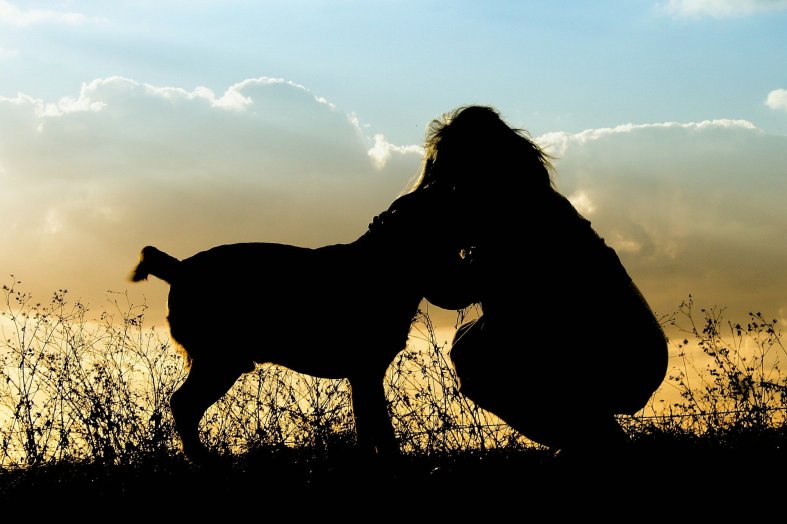
dog & person silhouette Image by Barbara Jackson from Pixabay

Image by Barbara Jackson from Pixabay

As an animal communicator, I walk with people and their animal friends through a lot of endings and beginnings.

The pain of loss is real and raw. It deserves respect. At the same time, you are here on earth with much love to give. Plenty of animals need loving homes.

Only you know whether and when to welcome another animal into your home, but here is my perspective along with a couple of things to consider.

Eight years ago this month, I lost my much-loved Idgie, the sweet diva of a tiger cat who inspired my first forays into animal communication and Reiki. Idgie had been sick, and she and I had been saying our see-you-laters for months. Deep down, I knew other feline friends would succeed her. At some point.
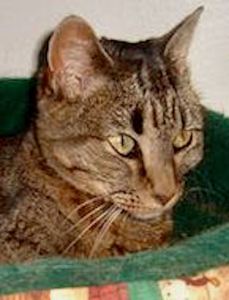
Idgie in cat bed 2007 crop

Idgie, 1996-2012

When I came home from the vet clinic and faced an Idgie-less, cat-less house, the pain hit me like the proverbial ton of bricks. It was all I could do to survive in the moment, much less think about the future.

Not long afterward, I read about a horrific animal cruelty case in which fireworks were tied to a kitten’s tail. Something opened up within me, and I realized how much I wanted to give another kitty a home. And Idgie had trained me so well.

One afternoon, I sat on my back porch and took a few deep breaths. My partner and I planned to visit the city shelter the next day. It was only six weeks after Idgie’s passing — was it too soon?

I connected with Idgie in spirit and asked her to guide us to our next feline companion, whenever and wherever it would best happen. What I received was her classic ears-back expression and: “Right. Like I wouldn’t be involved in that decision.”

At the shelter, Kathy and I met several kittens, but none seemed especially interested in us. Then the volunteer brought out one who was about to go to a satellite adoption center. The four-month-old black tortie prowled around the adoption counselor’s office, trying to figure out where she was and why. Then she came and sniffed both of us, accepting the gentle pets we offered.
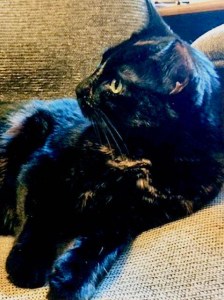
2012 Lucy on my desk chair crop

This is Lucy not long after we adopted her.

When I sensed the kitten was open to it, I gingerly picked her up. I commented on her distinctive coloring, notably the gold streak between her eyes that seemed to stop and resume on top of her head.

“Doesn’t it look like God came along with a paintbrush?” the volunteer said.

I held the kitten so that we were eye to eye. She reached out with one tiny black paw and patted my face.

We’d been chosen.

Did the joy of welcoming Lucy erase the hurt of losing Idgie? No. I still felt like crying every time I saw a tiger cat or a picture of one that reminded me of her. Lucy succeeded Idgie, but did not replace her. One being cannot truly replace another, and there’s no sidestepping grief if we are to love fully. While I continued to grieve for Idgie, my heart filled with gratitude for the love she had given me. That love enabled me to recognize the connection with Lucy, who needed a home as Idgie had.

The only thing I can imagine that’s worse than losing a pet is never having had that animal in my life. 

If you are struggling, or just wondering, here’s what I suggest:

  • Pay attention to your intuition. It’s hard to do this when you are in pain. But if you can, get quiet and ask yourself if it’s time to visit the animal shelter — or contact a rescue if you’re interested in a particular breed or type of animal. If you feel a lightness or sense of excitement and joy, that indicates a yes! If there’s a heavy, sad sensation, you might want to wait.
  • Adopt from a place of abundance, not lack. Another animal cannot truly replace the one you lost, or take away your pain. The last thing you want is to impose expectations on a new pet that are not about him or her at all. Stay with your grief long enough — however long that is — for your heart to open to a new and totally unique animal companion.
  • Remember the animal chooses, too. (Some animals would say they do all the choosing, but you get the idea.) My experience is that each dog, cat, bird, horse, human, or whoever comes into our lives for a reason. The animals probably have a better grasp of it than we do. When you meet a prospective new companion, pay attention to the way they respond and how you feel.

Whenever you and your next animal companion find each other, you are both signing on for a beautiful, painful, and totally worthwhile adventure. You both deserve no less.


‘Animals as Guides’ sheds light on difficult subjects

Photo by MabelAmber:Pixabay(Photo by MabelAmber/Pixabay)

As much as Susan Chernak McElroy gets it right with Animals as Teachers and Healers (Ballantine Books, 1997), she gets right to the heart with Animals as Guides for the Soul (Ballantine Books, 1998).

This follow-up is not only a worthy exploration of the relationship between humans and animals, but also a potentially transforming walk through some of the thorniest aspects of these relationships.

8482McElroy, who has worked as a technical writer and editor as well as in several animal-related occupations, writes largely from her experience on a small Wyoming farm. Insights from people who wrote to her after reading her previous book are included.

I appreciate so much in Guides for the Soul, but here are three primary take-aways.

The first is that the healing benefits of our relationships with animals are often subtle, but no less powerful. It isn’t always the spectacular, tossing-away-the-cane miracle with the therapy dog. More often, it’s the steady warmth of the cat curled up on the patient’s lap or the jingling of tags along a quiet country road day after day. Sometimes the miracle is only seen in hindsight.

“We are so conditioned to expect drama and heroics in healing that we forget the staggering importance of all the healing that goes unseen,” says McElroy, a cancer survivor. (Check out this wonderful six-minute video about two guys — one a morbidly overweight human, the other a middle-aged rescue dog — who healed each other.)

What if, she asks, we were to believe that the being at the end of the leash, in the cat carrier, or on a perch could heal by his or her very presence, offering exactly what is needed in every moment? That the dog nuzzling a crying adult was administering critical emotional first aid, or the horse heard the bullied teen as no one else could? Is that so far off the mark?

Second, McElroy delves into the rocky territory of death in a way that can benefit anyone who has lost a much-loved animal, particularly when the loss is accompanied by shame and guilt. These experiences and memories, however long ago, stick to us until we acknowledge their multilayered impact, she says.

Quoting respected authors on pet loss as well as people confronting long-buried grief and remorse, she offers perspective and tools for healing. However, she is respectful enough not to put forth easy answers. The stories of McElroy’s precious llama, Phaedra; and Jody Seay’s elderly black Lab friend McKenzie, are likely to bring both a tear and a spark of hope.

Finally, even when the animals involved are not our own, what can we do when we witness the inexplicable and cruel? When McElroy was about 11, a young coyote with his mangled leg still dangling in a steel-jaw trap was part of a wildlife exhibit at a nearby park. Day after day, he lay in a rusting wire cage with no food or water. She pleaded with the park rangers to care for the coyote. They ignored her. She begged her parents to do something, wrote to the local paper, and contacted the town mayor and her family’s veterinarian.

No adult would intervene until she called Mrs. Roberts, the mother of a friend, who picketed the park. The exhibit shut down within a week. The coyote made the front page of the local paper and was released to Mrs. Roberts, whose veterinarian husband helped care for the coyote in a backyard pen. Months later, Mrs. Roberts drove the coyote to the desert and released him back into the wild.

“She reminded me that although it was she who freed the coyote, it was I who had brought the coyote to her attention. At the age of eleven, I learned that one person can stand up against suffering and make a difference,” McElroy recalls.

We should all have, or be, a Mrs. Roberts.

The power of now for an angry dog

dog-486553_1920

I worked with an angry dog very much like this one during my Animal Reiki III training. (Photo by asommerh on Pixabay)

Normally, I steer clear of individuals — dogs or not — who are barking at me. But something drew me to Lyson despite his barking and the warnings posted all over his kennel at the animal sanctuary where I was doing my Animal Reiki III training with Kathleen Prasad.

The warnings were about keeping hands and fingers away from the cage, letting him out separately from the other dogs, and keeping him muzzled when he was out of the kennel. I could understand why, given the anger convulsing his body with every bark. I did not have Lyson’s backstory or any illusions about fixing whatever was bothering him. My classmates and I had dispersed around the barn to share Reiki with the animals, and that’s what I was going to do.

I pulled up a chair by his kennel and turned slightly to the side (some animals interpret your facing them directly as confrontation). I let both Lyson and Mojo, the dog in the next kennel, know they were free to take as much or as little of the energy as they wanted. It was completely up to them. Then I began my meditation, pulling in the energy of the earth and sky to remain grounded and connected to God.

Mojo sat quietly, cocking his head a bit. Lyson furiously barked and barked. I held a space of peace for both of them and myself, trying to remember the particulars of Kathleen’s “be the mountain” meditation. As a Reiki practitioner and empath, I have learned the hard way that taking on or getting sucked into another individual’s emotions or problems helps no one. It’s not mine to do. That’s the beauty of the Reiki space; it lets me care while stepping out of the way and allowing a higher wisdom to work.

A couple of times, Lyson stopped barking and went to the back of his pen. When he returned, he looked at me like he couldn’t believe I was still there, that someone was interacting with him in a way that did not involve violence or force. Then he started barking again.

About midway through the meditation, I looked down and noticed a mouse peeking out from a hole under Lyson’s pen. “Well, hi,” I said quietly. “You’re welcome to join us.”

As the session drew to a close, the mouse drew his nose back into the hole. Mojo relaxed, still curious about what the humans in the barn were up to. Lyson barked a couple more times just to make sure he got his point across. Before I rejoined my classmates at the other end of the barn, I briefly met his gaze. There was something about the healing energy we had just shared that he understood, even if it was just a tiny sliver. Perhaps that was wishful thinking on my part.

When I discussed my experience with Lyson, Mojo, and the mouse with the rest of the class, Kathleen said she heard Lyson was to be euthanized. Apparently, his aggressive behaviors had been deemed too severe for any other solution to be workable. She said it was good that I worked with him, that he got to have some positive interaction with human beings. I was fairly confident the decision was not made without careful assessment, love, and anguish.

Would I have loved to hear Lyson made a total turnaround during our Reiki training and was granted a reprieve … and if not adopted, at least able to live out his days among the other dogs at the sanctuary? Of course. But making that happen was not within our power, and practicing Reiki with a specific outcome in mind only blocks the healing energy you are trying to share.

Therein lies the tension between a Reiki practitioner’s natural and sincere inclination to help (and to want to see the results of said help) and the way healing actually works: with us mortals doing what is ours to do and leaving the rest to a power beyond ourselves.

What was ours to do that day at the barn was exactly what we did — share healing energy with the animals, regardless of what had brought them there or what may or may not happen after we left.

Sometimes, the only thing left to do is to offer someone a peaceful presence.

Maybe that’s what Lyson, in between his bouts of barking, began to understand.