Frustrated dog, cat, and horse owners will often enlist an animal communicator to get the animal to do what they want. They’ve tried and tried to get the cat to use the litter box, the dog to stop digging up the dahlias or the horse to just get on the trailer.
These are all legitimate concerns and ones I’m happy to address. However, animal communication is not about compliance. It’s about gathering information that will help animals and their humans find a way forward.
For example, a communication session can tell you:
• A noise from the water heater startles the cat in mid-pee. Moving the litter box out of the utility room, or adding one in a different spot, could make a big difference.
• Your dahlia-digging dog needs more enrichment. Which seems obvious, but he may also tell me that nose work or agility training would be even more fun than additional walks.
• The horse’s previous owner used force to get him to load. A small change — even you doing some deep breathing before you lead him to the trailer — would let him know he is safe now.
As with human brains, making the link between actions and consequences can be a work in progress. Nevertheless, knowledge is power, both for the animal knowing what the human wants and the human knowing where the animal is coming from. Why ask for compliance when communication gets you so much more?
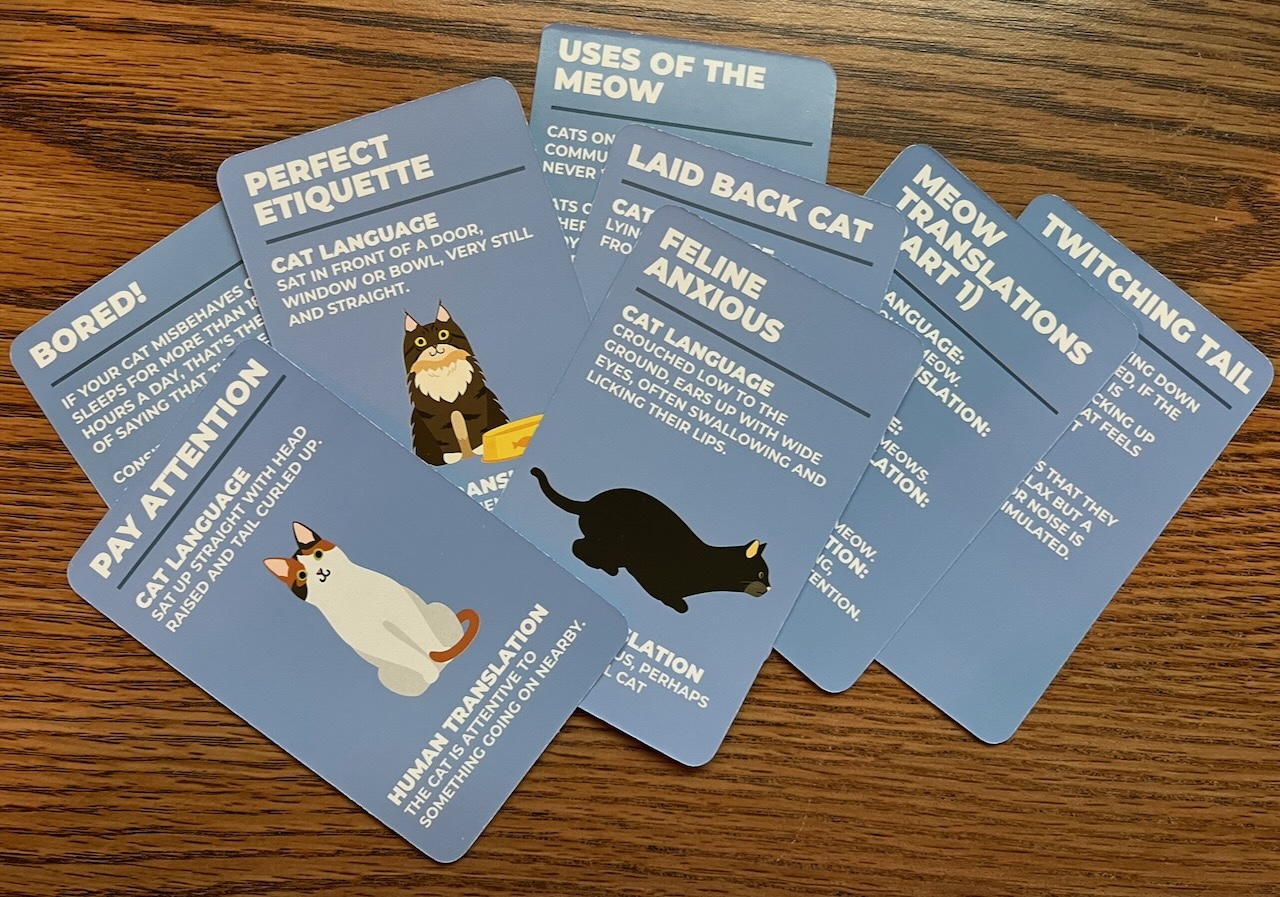
This 100-card deck, given to me for Christmas by someone dear, is a treasure trove of tips about twitching tails, different meows and more. Animal communication has many facets, especially where cats are concerned. Though cats have a reputation for being mysterious, they’re actually not if you learn what to look for.
While I’m no stranger to cat language of all types, I found new info here. For example, when a cat lies on his back and rolls from side to side, that is called “the social roll.” It has a name and indicates a willingness to interact. “It’s safe to pick up the cat, just don’t go for the belly!” the caption explains.
According to another card, a stretch means the cat has been stressed but is now relieved. I’m less sure about this one, as most of my cats’ stretches follow naps. There’s always that one cat who does things differently. Like my calico, who this morning did a stretch followed by a social roll. Then she declined to play with the dangle toy I offered. When I asked what she actually wanted, she went to get a drink of water.
As a proponent of indoor cat living, I disagree with the card that suggests letting your cat out. Double ditto for the one that suggests searching after she’s been gone for three days. (Um, try three hours. Max.)
The record for the loudest cat purr, by the way, is held by a cat named Merlin who could purr at 67.8 decibels. That’s about as loud as a shower.
Lovers of cats and fun facts will find this a great conversation piece to keep on a bookshelf or coffee table. You can pull one a day to see what new insight you might find about your feline friend. It might be spot on, or it might make you wonder if only their creator truly has cats figured out.
As an animal communicator, I occasionally hear or sense this from our four-legged and other friends.
Usually it’s because their human has asked me to help them understand an upcoming move, addition to the family, or other change. Or maybe he or she has hired me to help sort out a behavioral issue.
The animal understands the situation. He may understand what the human wants. But you’re not seeing the change you hoped for.
“I get it. But I don’t like it.”
So the animal keeps nipping, scorning the litter box, or refusing to load. The problem continues after the vet visit, the session with me, your efforts to help, or all of the above. What on earth can you do?
First of all, understand that I can make your wishes known to your animal, but there is no guarantee she will comply. Compliance isn’t the point anyway.
So back to the “what can you do” part:
Let it be. You want to do something — anything — to resolve this problem yesterday, but remember you’ve already planted the seeds for something better.
Some situations resolve themselves in ways understood only by the animal. The cat decides the new baby isn’t a hairless monster. The horse loads when another person tries. The dog feels better and eats the special diet more readily.
You may choose to do something else tomorrow. Today, let go and see what happens. The animal will feel the change in your energy.
Give the animal a choice. Offer an additional litter box. Try getting the donkey onto the trailer tomorrow rather than force him today. If your dog doesn’t want to be around your boyfriend, let her stay where she feels safe.
Letting the animal choose boosts her confidence in herself and in you. That can only improve your relationship and the situation.
Savor (and reward) the small victories. The new cat and the current cat come within three feet of each other without hissing. The dog stops barking the first time he’s asked. This is great! Pony up (so to speak) with praise, a treat, or a play session
Ask for more help. Your animal may be telling you she needs (if you’ll pardon a tired old job rejection phrase) to move in a different direction. If you are still struggling, I will do my best to refer you to a trainer, organization, business, veterinarian, another practitioner or communicator, or someone else through trusted sources. Or you can ask a trusted friend for referrals. It does take a village.
Similarly, don’t hesitate to (diplomatically) let your veterinarian know that you need some other ideas. He or she is on your side, and on your animal’s side.
Also remember every state has veterinary schools — Purdue, here in Indiana — whose mission it is to help people help animals.
There are ways to bridge the gap between understanding and integrating. As with us humans, it may take patience, creativity, and additional support.





 All Creatures