Frustrated dog, cat, and horse owners will often enlist an animal communicator to get the animal to do what they want. They’ve tried and tried to get the cat to use the litter box, the dog to stop digging up the dahlias or the horse to just get on the trailer.
These are all legitimate concerns and ones I’m happy to address. However, animal communication is not about compliance. It’s about gathering information that will help animals and their humans find a way forward.
For example, a communication session can tell you:
• A noise from the water heater startles the cat in mid-pee. Moving the litter box out of the utility room, or adding one in a different spot, could make a big difference.
• Your dahlia-digging dog needs more enrichment. Which seems obvious, but he may also tell me that nose work or agility training would be even more fun than additional walks.
• The horse’s previous owner used force to get him to load. A small change — even you doing some deep breathing before you lead him to the trailer — would let him know he is safe now.
As with human brains, making the link between actions and consequences can be a work in progress. Nevertheless, knowledge is power, both for the animal knowing what the human wants and the human knowing where the animal is coming from. Why ask for compliance when communication gets you so much more?
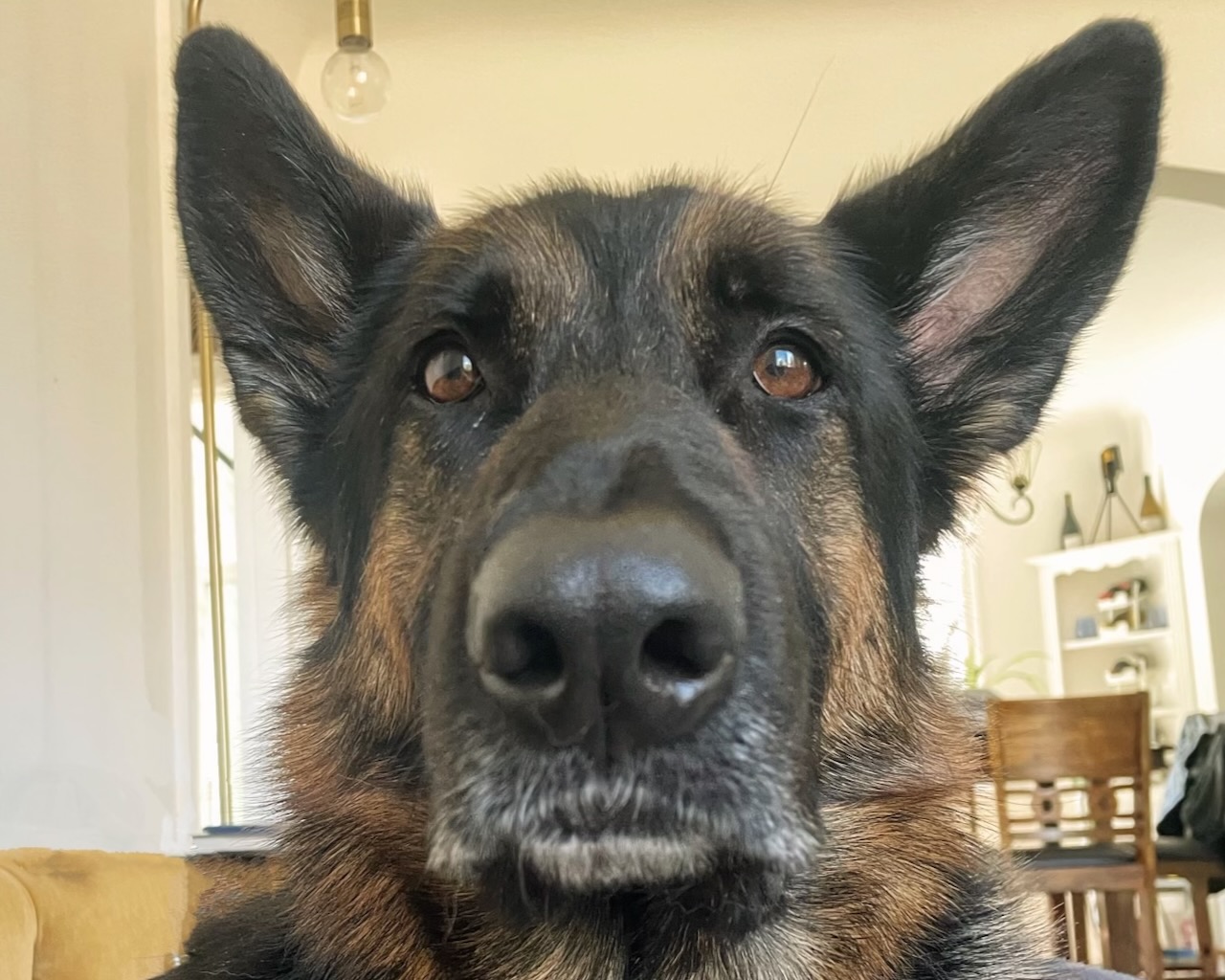
As the July 4 fireworks intensified, Iona the German shepherd trotted from one window to another — an elevated version of what her mom calls (and I paraphrase) guard dog stuff.
By the time night fell, a calming chew had taken the edge off, but she was still distressed by the pops, bangs and booms she could hear and feel but not see. How was she supposed to respond to this threat with insufficient data?
I told Iona, as I’ve been telling animals for decades, that it’s just human noise. It’s rattling, to be sure, but manageable. Even though she couldn’t see the source of the noise, she was safe at home and we would ride it out together.
My partner, our honorary daughter, Iona and I settled in to watch a movie. Eventually, Iona curled up on the sofa (of course she’s allowed) with her mom, and a bit later she shifted around and stretched out with her head in my lap. I told her she was very brave even if she didn’t feel brave.
On the same night, a client of mine sat on the pasture fence as horses gathered around her. The humans on the nearest street seemed to have an endless supply of fireworks, and she stayed with the herd until the worst was over.
We are all confronted with “noise” that scares, confuses or angers us. We can’t control it, but we can manage its impact. One way is by acknowledging it and being present.
Even when we perceive the sound differently (say, like a dog and a human), we can sit quietly together and see if something better surfaces. Even if it’s just a kind word or an ear scratch.
A University of California study gives scientific credence to what we’ve known all along: Dogs get jealous.
The 2014 study by Christine R. Harris and Caroline Prouvost found that when their owners displayed affection toward an animatronic stuffed dog that barked, whined, and wagged its tail, the dogs snapped at and pushed against the stuffed dog and tried to get between it and their human.
The 36 dogs were videotaped at their homes while their owners ignored them and interacted with a series of three objects: the stuffed dog, a children’s book, and a plastic jack-o-lantern.
The study looked only at small-breed dogs such as corgis, pugs, and dachshunds, apparently so the dogs would be easier to control if things got out of hand. One of my favorite sayings is, “The smaller the dog, the bigger the attitude,” but I’ve seen dogs of every size, breed, and temperament get their noses out of joint over having to compete for a human’s attention.
The dogs in this study were much more miffed by the stuffed dog, and more specifically the human’s interactions with it, than they were by the person reading aloud from the book or showering attention on the pumpkin.
Being ignored in favor of an inanimate object is one thing. The interaction with something so doglike that its butt had to be sniffed (which 86 percent of the dogs in the study did) made the difference. The study was published in PLOS One, a peer-reviewed online scientific journal.
So, how much of a problem is canine jealousy? Relatively little snapping was reported on the part of the dogs in this study. Since dogs are not inclined to hold grudges, it’s reasonable to assume that the next time you encounter the phrase “jealous rage,” it will not apply to a dog’s behavior.
Still, there is an important reminder here for maintaining a more just and happy household: There’s no substitute for one-on-one time.
If a friend’s dog is staying with us, Molly — our golden retriever/German shepherd/collie rescue with her share of issues — is fine with sharing her space and toys. But if my partner or I pet the guest dog, Molly wedges herself between us. This is when I make sure Molly gets just as much attention and lap time (yes, my 60-pound dog thinks she’s a lapdog) as she normally does. This makes her feel more secure and lets the visitor know where he stands.
It’s also not unusual for animals to feel threatened by the arrival of a new four-legged family member. Every time an animal joins or leaves a household or herd, that small civilization shifts. The rules and hierarchies are reset.
This is especially true for cats, whose independence and territorial nature does not preclude forming strong bonds with other animals and humans. Spending some one-on-one time, even if it’s just a few minutes a day of play, walking, or snuggling, with each animal will help everyone (including you) feel fully loved and appreciated.
Of course, thanks to the power of the canine nose, a potential rival need not be present to merit suspicion. When I go home after an in-person animal Reiki session or my rounds at Summit Equestrian Center, I can count on a thorough sniff-over from Molly. She gathers all kinds of data about where I’ve been and with whom.
While she doesn’t entirely approve, generally within a few minutes she’s ready to move on to something else — going outside, angling for a treat, or making sure the UPS man knows the premises are protected. I still make sure she knows that even though I have been out working with other dogs (and cats, horses, pigs, sheep, etc.), I am happy to see her.
Like our previous dog, Ellie, Molly also has a knack for coming into the room and settling beside me when I’m sending distant Reiki energy to an animal, especially another dog. She doesn’t mind … but she doesn’t want to be left out, either. Fortunately, there is always enough Reiki to go around.





 All Creatures