Ready to adopt again?

In my experience, there’s no right or wrong amount of time to wait before adopting again after you’ve lost a beloved animal. The challenge is to respect yourself and your grief while being willing to be surprised. 

Years ago I lost my much-loved Idgie, the sweet diva of a tiger cat who inspired my journey into animal communication and healing. The pain was, in fact, like the proverbial gut punch. 

A few weeks afterward, I read about a horrific local animal cruelty case in which fireworks were tied to a kitten’s tail. That kitten received treatment, foster care and a loving home, but something opened up within me. I realized how much I wanted to give another kitty a home. And Idgie had trained me so well.

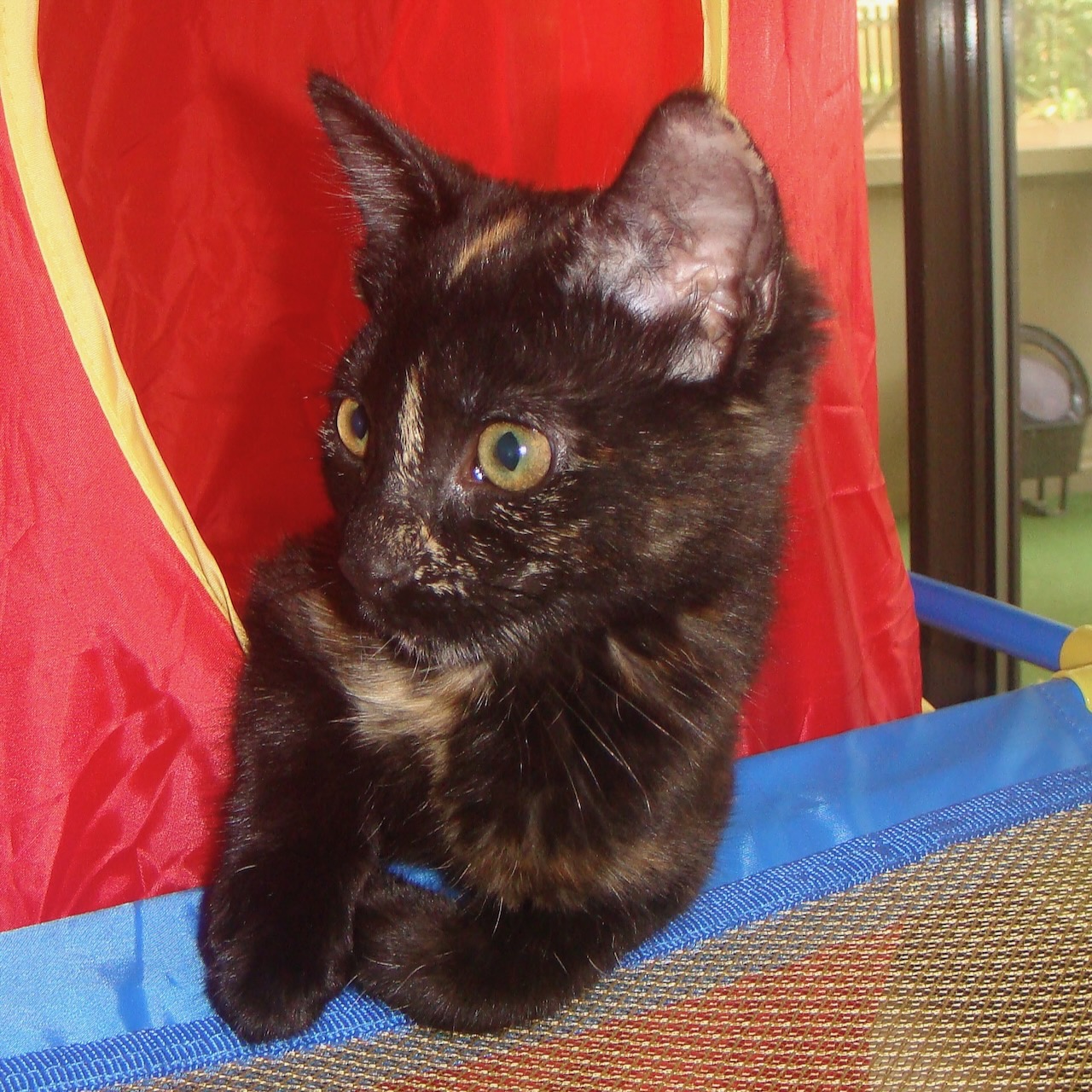
At the city shelter, Kathy and I met several kittens, but none seemed especially interested in us. Maybe now wasn’t the time after all, I thought. Then the volunteer brought out one who was about to go to a satellite adoption center. The four-month-old black tortoiseshell kitten prowled around the adoption counselor’s office, trying to figure out where she was and why. Then she came and sniffed both of us, accepting the pets we offered.

When I sensed the kitten was open to it, I picked her up. I commented on the gold streak between her eyes that seemed to stop and resume on top of her head.

“Doesn’t it look like God came along with a paintbrush?” the volunteer said.

I held the kitten so that we were eye to eye. She reached out with one tiny black paw and patted my face. We’d been chosen.

Did the joy of welcoming Lucy erase the hurt of losing Idgie? No. Lucy succeeded Idgie, but did not replace her. One being cannot truly replace another, and there’s no sidestepping grief if we are to love fully. While I continued to grieve for Idgie, my heart filled with gratitude for the love she had given me. That love enabled me to recognize the connection with Lucy, who needed a home as Idgie had.

A few takeaways, as long as you’ve read this far:

• Pay attention to your intuition. A lightness or sense of joy generally indicates a yes; a heavy, sad sensation a no or a not yet.

• Stay with your grief long enough, however long that is, for your heart to open to a new and unique animal companion. 

• Remember the animal chooses, too; pay attention to the way a prospective new companion responds to you and how you feel. 

Whenever you and your next animal companion find each other, you are both signing on for a beautiful, painful, and totally worthwhile adventure.


‘Animals as Guides’ sheds light on difficult subjects

Photo by MabelAmber:Pixabay(Photo by MabelAmber/Pixabay)

As much as Susan Chernak McElroy gets it right with Animals as Teachers and Healers (Ballantine Books, 1997), she gets right to the heart with Animals as Guides for the Soul (Ballantine Books, 1998).

This follow-up is not only a worthy exploration of the relationship between humans and animals, but also a potentially transforming walk through some of the thorniest aspects of these relationships.

8482McElroy, who has worked as a technical writer and editor as well as in several animal-related occupations, writes largely from her experience on a small Wyoming farm. Insights from people who wrote to her after reading her previous book are included.

I appreciate so much in Guides for the Soul, but here are three primary take-aways.

The first is that the healing benefits of our relationships with animals are often subtle, but no less powerful. It isn’t always the spectacular, tossing-away-the-cane miracle with the therapy dog. More often, it’s the steady warmth of the cat curled up on the patient’s lap or the jingling of tags along a quiet country road day after day. Sometimes the miracle is only seen in hindsight.

“We are so conditioned to expect drama and heroics in healing that we forget the staggering importance of all the healing that goes unseen,” says McElroy, a cancer survivor. (Check out this wonderful six-minute video about two guys — one a morbidly overweight human, the other a middle-aged rescue dog — who healed each other.)

What if, she asks, we were to believe that the being at the end of the leash, in the cat carrier, or on a perch could heal by his or her very presence, offering exactly what is needed in every moment? That the dog nuzzling a crying adult was administering critical emotional first aid, or the horse heard the bullied teen as no one else could? Is that so far off the mark?

Second, McElroy delves into the rocky territory of death in a way that can benefit anyone who has lost a much-loved animal, particularly when the loss is accompanied by shame and guilt. These experiences and memories, however long ago, stick to us until we acknowledge their multilayered impact, she says.

Quoting respected authors on pet loss as well as people confronting long-buried grief and remorse, she offers perspective and tools for healing. However, she is respectful enough not to put forth easy answers. The stories of McElroy’s precious llama, Phaedra; and Jody Seay’s elderly black Lab friend McKenzie, are likely to bring both a tear and a spark of hope.

Finally, even when the animals involved are not our own, what can we do when we witness the inexplicable and cruel? When McElroy was about 11, a young coyote with his mangled leg still dangling in a steel-jaw trap was part of a wildlife exhibit at a nearby park. Day after day, he lay in a rusting wire cage with no food or water. She pleaded with the park rangers to care for the coyote. They ignored her. She begged her parents to do something, wrote to the local paper, and contacted the town mayor and her family’s veterinarian.

No adult would intervene until she called Mrs. Roberts, the mother of a friend, who picketed the park. The exhibit shut down within a week. The coyote made the front page of the local paper and was released to Mrs. Roberts, whose veterinarian husband helped care for the coyote in a backyard pen. Months later, Mrs. Roberts drove the coyote to the desert and released him back into the wild.

“She reminded me that although it was she who freed the coyote, it was I who had brought the coyote to her attention. At the age of eleven, I learned that one person can stand up against suffering and make a difference,” McElroy recalls.

We should all have, or be, a Mrs. Roberts.

Mismatched sand dollars

198414763_32ccdcb344_bIt’s the task adult children dread: Sorting through the detritus of a parent’s life, however well-lived, while also sorting through grief.

My mother loved her independent apartment in a Southwest Florida retirement community. She had a blast furnishing it 10 years ago, and she got to stay there until she died a couple of days after Christmas (see obit). She’d moved there on her own initiative and resisted being hustled into assisted living. Mom had already pared down quite a bit before moving into her apartment, but when you’re 90, you’ve still got plenty of stuff.

In one drawer was an abundance of earrings, many of which I could not remember her wearing. They were all organized — worn and put carefully back in place. Except for one pair of gold sand dollar post earrings. One had been bent, possibly stepped on. They were both little gold(ish) sand dollars, but they didn’t match. Their hues and patterns were different enough for me to notice, but similar enough for Mom’s eyesight. How similar are any two sand dollars on the beach, anyway?

I poked around for the other sand dollar earrings, but did not find them. That’s how it is. We accumulate experiences, emotions, relationships, scars and stuff. Not all of it matches and some of it’s a little bent out of shape, but it’s ours. We hope that what we don’t take with us will benefit someone somehow, even just to leave a smile.

The sand dollar earrings went into the “keep” box. Life doesn’t match up. Wear it and rock it anyway.

Photo credit: tashland via Foter.com / CC BY-NC-ND