

“Rest in Peace,” https://www.flickr.com/photos/claire-ridge/
It’s impossible for me to watch shows like “Ocean Mysteries” and “Sea Rescue” without feeling torn up over the way we are tearing up our world. The seal with the fishing line tightening around its neck, cutting into the flesh. The pelican with the pouch someone slashed with a knife. And of course the oil-covered fish, birds, and other creatures. The lovely image above was the artist’s response to the 2010 Gulf of Mexico oil spill. The world needs to know this and consider the implications, I remind myself. There is more to learn.
A recent episode dealt with a giant Pacific octopus who’d deposited some 20,000 eggs in her habitat at a marine life center. She would care for these eggs constantly. And that would be her final act, as octopuses die around the same time as their eggs hatch. Paul, the World Cup-match-predicting octopus in Germany, only lived to be two and a half years old, and that was considered a normal octopus lifespan.
This is not human cruelty or carelessness; it’s nature. We can do any number of things to take better care of our earth and help where there is hurt. All we can do about the incredible sadness of things like this is to stay present and keep learning.
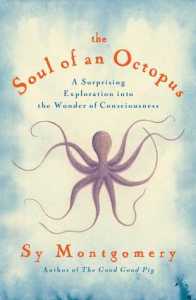 A short time later, I found The Soul of an Octopus: A Surprising Exploration into the Wonder of Consciousness (Atria Books, 2015) at a bookstore. The book grew out of author Sy Montgomery’s article in Orion magazine about her unique friendship with an octopus named Athena at the New England Aquarium. Octopuses (not octopi, she says) are intelligent creatures who solve problems, change colors according to their health and mood, and recognize the people who care for them.
Most of the book centers around the New England Aquarium and the staff and volunteers who care for a succession of Giant Pacific octopuses there. Montgomery describes her first “handshake” with Athena — octopuses taste with their entire bodies, but their suckers are the most sensitive — as “an exceptionally intimate embrace.” When Athena died suddenly, Montgomery, who felt she was just getting to know this new invertebrate friend, was surprised by her grief.
Other octopuses would cross her path, notably Octavia. “I stroked her head, her arms, her webbing, absorbed in her presence. She seemed equally attentive to me.” Octavia also mischievously hosed a high school student job-shadowing Montgomery for the day. As Octavia began to age, the aquarium acquired young Kali, an inordinately curious escape artist. Then there was Karma, who arrived with part of her second right arm missing.
Also compelling are the stories of the humans Montgomery works with, including sixteen-year-old volunteer Anna, who has Asperger’s syndrome, a few health problems, and a host of fish tanks at home. “Going behind the scenes at the aquarium changed my life,” she says.
Though I do have reservations about animals such as octopuses being kept in captivity, reputable aquariums serve a valuable purpose. They provide ways to learn about and connect with sea life that would be far less likely or impossible in the wild. This sort of connection translates much more readily to caring and conservation than, say, abstractly hearing over and over again about the importance of conservation. The aquariums that lean more toward amusement parks or other commercial enterprises? Maybe not so much.
Of course, caring comes with a cost, such as feeling torn up inside when animals suffer or natural wonders are trashed. Or grieving over the loss of friends (of any species) whose time on earth seems absurdly short.
Still, we reach out — to hold hands with an octopus, plant a garden, recycle a pop can, or do any other seemingly small thing that keeps the regenerative force of caring alive.

 All Creatures