This season reminds us that the humblest places — barns, pastures, homes — not only provide safety but connect us to something bigger. So many of these connections happen in the company of/because of our animal friends.
As an animal communicator and Let Animals Lead® practitioner, I’ve been privileged to share many such moments this year. Please enjoy this three-minute video honoring them. (Sound up … breathe.)
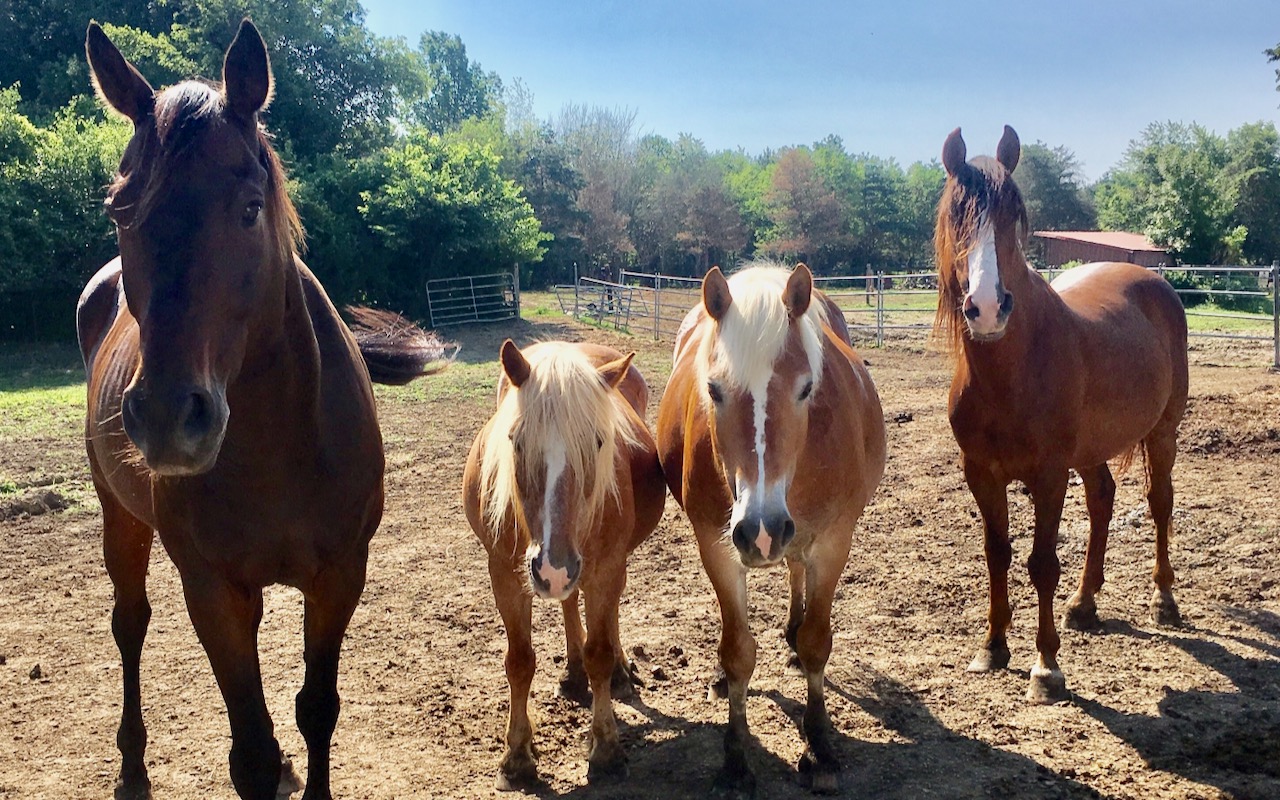
A thoroughbred, two Haflingers and a mustang walk into a bar … and chances are, Emmie (second from right) would get everyone home safely.
Reading the second, revised and updated edition of Mark Rashid’s Horses Never Lie: The Heart of Passive Leadership immediately brought Emmie to mind. This unassuming Haflinger stepped up — as she does for so many other duties as a therapy horse — as herd matriarch after the much-loved Lola passed three years ago. I’ve had the pleasure of working with Emmie and many of her herd mates for several years as an animal communicator and Let Animals Lead® animal Reiki practitioner.
Though she has her moments, Emmie is not one to nip, kick, shove, or use other aggressive tactics. Leading by example and not force is what makes her effective. Once I watched her stand quietly with Geronimo (at far right in the photo) after Geronimo’s behavior got him grounded, so to speak. I didn’t get the feeling Emmie was conveying either reproach or sympathy. Just standing nose to nose with him in the pasture helped him calm down and see how not to mess up.
Rashid, over years working at a ranch, discovered that mimicking just this sort of lead horse helped the humans gain the horses’ trust. “A horse that is extremely dependable and confident, one that the vast majority of horses will not only willingly choose to follow, but that they actually seek out,” he wrote in the introduction.
Key to this leadership is “finding the try,” which Rashid discovered as a youth working for an unnamed “old man” who turned out to be one of his greatest (human) teachers. After Rashid repeatedly tried and failed to teach a horse to back up, the old man taught him to notice the subtle ways the horse was actually trying to do what he wanted, and to respond in kind.
“There was a little brace here, a little give there, a slight jiggle of the bit, a tipping of her nose, a little bending at the poll — all within a few seconds,” Rashid recalled. Responding to these with released pressure, a pet on the neck or even just a pause led to more tries, and soon the horse was backing up with ease.
Fight with a horse and the horse will fight back, the old man advised, but “even during those fights, the horse is still trying to figure out what you want. The sad part is, because you’re so busy fighting with them, you’ll never feel those tries.”
It made me wonder how many times I’ve failed to notice someone trying to meet me halfway. Any of us can get so caught up in our own efforts that we don’t see how the other person, or animal, is actually trying to work with us.
It’s worth pausing and getting quiet enough to listen to the subtleties.
In his second-edition notes, Rashid wrote: “In the years since writing this book, and in particular this chapter, I have come to understand that a horse’s ‘try’ is very often even smaller than what I understood it to be back then!”
This is one of sixteen malnourished, neglected horses taken from a northeast Indiana farm last winter. (Photo courtesy Friends of Ferdinand)
Sixteen horses — first 10, then another six — were rescued from a Wells County, Indiana property in January 2018. All were malnourished, and some had untreated infections and injuries.
A few, including two of the six horses I worked with, did not survive. Others returned to their previous owners or found new ones, but faced a long and difficult healing process.
The case was all the more disturbing because the person responsible was known and trusted by area horse owners and rescuers. Yet, according to the conversations that followed, there were previous signs that all was not well.
What can we pull from this to create a better outcome the next time something doesn’t seem quite right, but we don’t know what to ask or how to help? How can we get better at spotting signs of animal abuse and neglect, speaking up, listening, and following through?
As I write this, winter is coming. That’s when many of these heartbreaking situations come to light, and when it’s difficult to respond.
I’m not a veterinarian, horse handler, or law enforcement officer. My job with horses is to listen to them, and to the people who love and care for them, and offer a calm presence that allows healing. But as a journalist of many years, I also wanted to offer some quality information that might prove useful to those of us in northeast Indiana and beyond. Here’s what I found.
• Also of note: Friends of Ferdinand, which played a key role in the rescue of the horses in the above case, received a Standing Ovation by Ovation Riding in 2018. This story talks about how other rescue organizations stepped in to help.
Creating a better world for horses (and everyone else) does, in fact, take all of us.


 All Creatures