
I caught Dolly in the middle of lunch with hay on her face, but her star quality shines through.
There are many rules for naming racehorses, but none for your average equine citizen. From what I’ve observed, horses often get new names when they get new people, new homes, new jobs, a second chance, or any combination of these. Some retired racehorses, like my friends Beau and Pirate, go by shorter versions of their racing names.
This isn’t unique to horses. Look at the way we humans take on and drop nicknames, take spouses’ names, reclaim family names, hyphenate, and depending on who’s talking, go by names like Mom.
One horse I know chose a name his new person wouldn’t have picked in a million years. Another came by hers through blonde star synchronicity. Yet another, when given the choice, kept the name she had.
Duke
I felt the sadness of the 17-year-old shire as soon as Allison Wheaton, director of Summit Equestrian Center, sent me his photo. After years as an Amish farm horse, and apparently not the best of situations, he was to become Summit’s newest resident late last year.
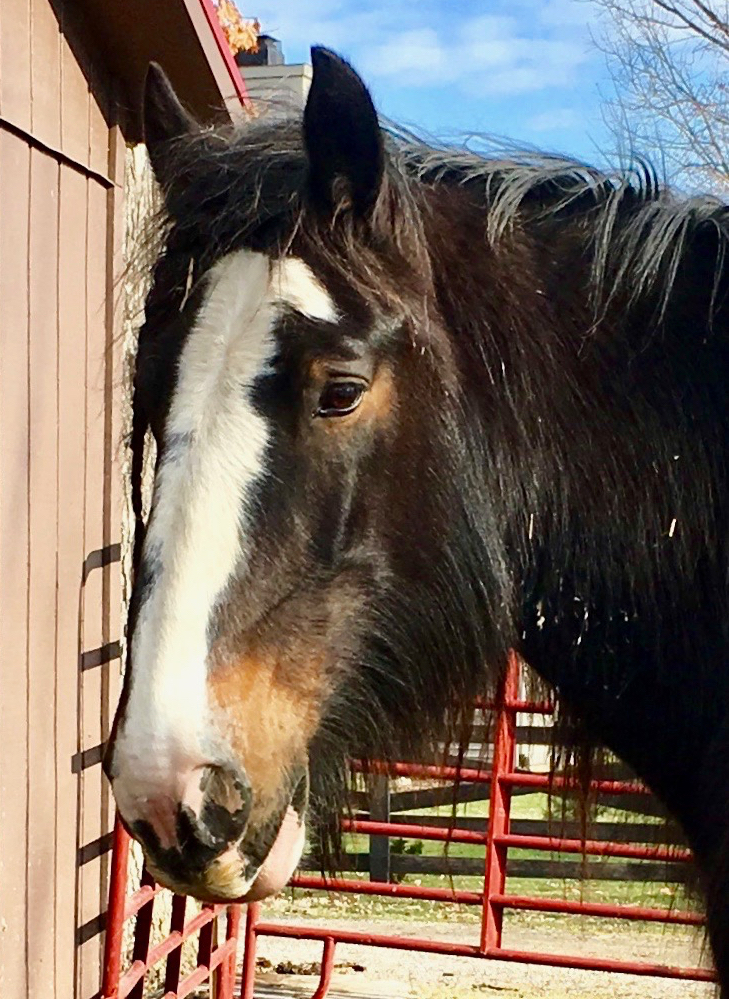
This is Duke a few months after his arrival at Summit Equestrian Center. He still wasn’t out with the herd, but he’d decided he liked Reiki. (Photo by Nancy Crowe)
Allison asked me to communicate with him before he arrived and find out what he needed in the transition, and what he might like to do. And would he like a new name, or would he prefer to keep the one he had (Angmar)?
The notion that he had a choice about anything was a strange concept to this heavy-hearted soul. Yet when I asked him what he wanted to be called, I heard: “Just call me Duke.”
I passed that along. Since most school/sports rivalries are not on my radar, it didn’t occur to me that Allison, a University of North Carolina grad, might wince at the name of her alma mater’s chief rival. As I learned later, she had vowed never to name a dog, horse, or anything else Duke. But Duke it was.
As fall deepened into winter, Duke acclimated and found his footing as a therapy horse. He found he appreciated being listened to and liked Reiki, especially once he realized it was his choice. Getting him to the point where he could join the rest of the horses in the pasture took months, many introductions, and a few scuffles.
Then one day this spring, Duke caught my eye from across the pasture. He was standing up straight, ears forward, with the rest of the crew.
“Do you see where I am? Do. You. See. Where. I. Am?” I heard.
Yes, Duke … I see you.
Dolly
Malibu, a Tennessee Walker-Belgian cross, had a few different homes by the time she joined the Summit herd. No one seemed to have time for her, and now she had no idea where she belonged.
Three or four days later, “Hello, Dolly!” — from the musical of the same name — got stuck in my head. I listened to the album over and over as a child and saw Carol Channing in what many consider her signature role as Dolly. But I hadn’t heard it recently or thought of it much.
The day after that, I received a text from Allison that the newcomer had settled in a bit, but Malibu didn’t seem like the right name. “Dolly? There’s got to be a sassy blonde star name that fits better,” she said.
I told her about the musical and sent a video link to the song. It includes the lyric “Tomorrow will be brighter than the good old days.”
Allison was thinking of Dolly Parton and I was thinking of the fictional Dolly Levi — but both seemed to fit. So Dolly it was, and she’s already shed stardust on a couple of participants in Summit’s veterans program.
Lulu
Some horses keep their names. Lulu, a beautiful paint mare, was rescued from a horrible neglect situation. As Lulu began a new chapter at Summit, Allison asked me to see if she wanted a new name as well … like Cheyenne?

Lulu has been learning to trust again.
When I asked Lulu, she told me she knew who she was and it didn’t matter what the humans called her. Cheyenne was fine, but she was also fine with sticking with Lulu, so that’s what we did.
Recovery is all about ups and downs, and less than two years later, Lulu’s is no exception. She has a good buddy in Pirate, one of the aforementioned retired racehorses, and she’s helped some of Summit’s human clients heal their own wounds. Every time I check in with her, even if she is struggling with the effects of her past, I see her choose to give her new life — still as Lulu — a chance.
You tell me …
How did your horse friends get their names … or new names?


 All Creatures