When people are cruel to one another, animals feel it. This happens when they experience trauma – such as witnessing the fatal shooting of one of their humans, as Renee Good’s dog did.
I would tell you it also happens when they sense the grief and pain their humans feel over such events, even far away. A horse told me last week he knew human cruelty was “out there” and that it made his beloved person feel angry and discouraged. Then he showed me an image of himself with all four feet planted firmly on the ground: “There is good.”
A few days later, after I read about the killing of Alex Pretti, one of our cats climbed into my lap and gently kneaded my chest, looking into my eyes and purring. This face-to-face kneading was a departure from her usual facing-out, turning-around-a-few- times kneading. Of course she had no idea who Alex Pretti was, what ICE is or what immigration means. No doubt she picked up on the energy and images I carried away from that news story. She knew it was something happening in the human world, and she was there providing evidence of what is good in said world.
I don’t know much about policy or politics, but I know that treating people as if they don’t matter is not only wrong but unnecessary. We can be fair to strangers of all stripes. We can ask better questions. We can, and must, create a kinder world for animals and ourselves.
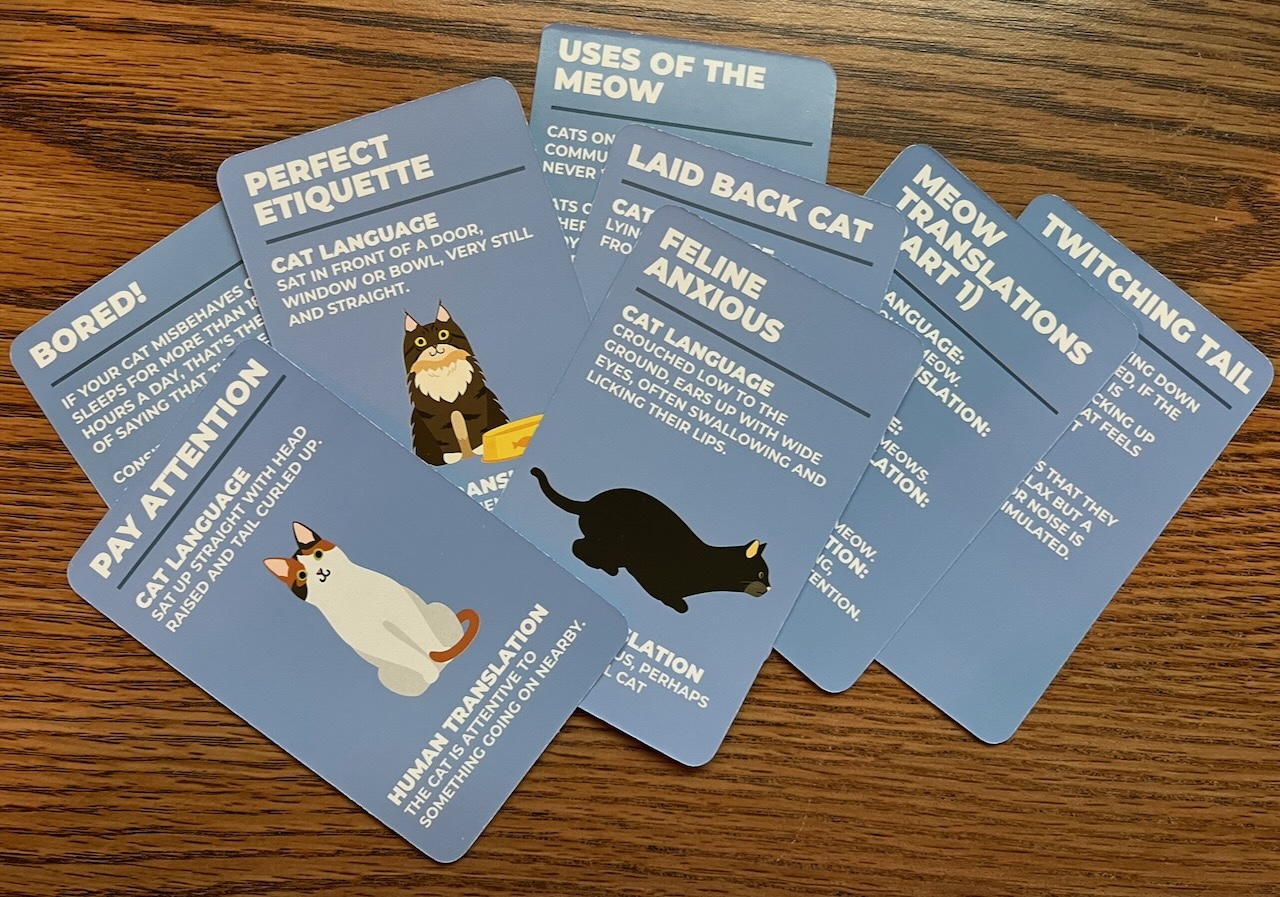
This 100-card deck, given to me for Christmas by someone dear, is a treasure trove of tips about twitching tails, different meows and more. Animal communication has many facets, especially where cats are concerned. Though cats have a reputation for being mysterious, they’re actually not if you learn what to look for.
While I’m no stranger to cat language of all types, I found new info here. For example, when a cat lies on his back and rolls from side to side, that is called “the social roll.” It has a name and indicates a willingness to interact. “It’s safe to pick up the cat, just don’t go for the belly!” the caption explains.
According to another card, a stretch means the cat has been stressed but is now relieved. I’m less sure about this one, as most of my cats’ stretches follow naps. There’s always that one cat who does things differently. Like my calico, who this morning did a stretch followed by a social roll. Then she declined to play with the dangle toy I offered. When I asked what she actually wanted, she went to get a drink of water.
As a proponent of indoor cat living, I disagree with the card that suggests letting your cat out. Double ditto for the one that suggests searching after she’s been gone for three days. (Um, try three hours. Max.)
The record for the loudest cat purr, by the way, is held by a cat named Merlin who could purr at 67.8 decibels. That’s about as loud as a shower.
Lovers of cats and fun facts will find this a great conversation piece to keep on a bookshelf or coffee table. You can pull one a day to see what new insight you might find about your feline friend. It might be spot on, or it might make you wonder if only their creator truly has cats figured out.
Having Mojo tell me what he needed, and relaying that to his human and an equine bodyworker, helped us all help him feel better.
As a non-veterinarian, I do not diagnose or treat. As an animal communicator, I do sometimes get information about sore hips and hooves, tummy discomfort, itchy spots and more.
Sometimes the animal’s human caretaker tells me about any health issues going in. When I’m on rounds I always check in with the humans ahead of time for any updates (health included). Sometimes the animal himself will tell me about a health issue — or show me through images or feelings — during a communication session.
When a client arranges a session, “What does your vet say?” is one of my first questions. I want to make sure that any medical reasons for the cat not using the litter box or the dog’s increased anxiety have been addressed and ruled out.
Medical or otherwise, “what’s wrong” is never the focus of a communication session anyway. That’s because all of us living beings are so much more than our symptoms, illnesses, injuries and seemingly odd behaviors. No animal’s illness or trauma changes the fact that she is a unique creation with an inner light all her own.
After an animal communication session I relay any information the animal chose to share, including anything that might relate to health, to the human carer. The human can then choose to ignore it, keep an eye on it or share it with the vet. As I tell clients: Take from this only what resonates and is helpful, and leave the rest.
Much the same goes for my Let Animals Lead® sessions. In this specialized form of Reiki, the practitioner never “beams” energy to the animal (or any body part thereof) the way a practitioner might in a human Reiki session. Because Let Animals Lead® is meditation-based, a session is a quiet time to relax and reset. Though this method is not about fixing anything (and I keep the Serenity Prayer close), relaxation can only help with healing, whatever healing might mean for the animal in that moment.
It’s important to note that Let Animals Lead® is hands off unless the animal initiates contact. Many do, especially if they’ve been working with me for a while. Mojo, a Tennessee Walking Horse, once backed up against the fence between us and asked for hands-on energy. He showed me some pain in his hips and along the left side. I placed both hands on his hips and began my meditation. After a while he began licking and chewing, then walked off to join the rest of the herd. I passed this along to Mojo’s human and to the equine bodyworker who also worked regularly with him. After her session with him a day or two later, she sent me a diagram to show how she adjusted a misalignment on the left.
The codes of ethics I follow for both animal communication and Let Animals Lead® are clear about not dispensing medical advice or treatment. They’re also pretty clear about showing up and doing what we can do. It does take a village, and I try to do my part in it.




 All Creatures