Is Reiki in our hands?

4976097279_fe5c163c2d

Photo credit: DomiKetu via Foter.com / CC BY-NC-ND

“Your hands are on fire,” my Reiki teacher said during the attunement, or initiation, to Reiki II a decade ago.

How ironic. Usually I heard, “Good God, your hands are freezing!”

I had noticed my hands were warmer after being attuned to Reiki I earlier that year. One of my classmates, who was also a palm reader, had hands so hot they almost burned. Obviously, this was powerful stuff.

It’s not unusual for those who practice Reiki — or for those receiving the energy — to feel heat flowing through our hands. And it makes sense. Our hands are how we take action, take responsibility, and get things done. Reiki has a long and important tradition as a hands-on healing modality.

Yet how much of the practice of Reiki is actually in our hands, literally or figuratively?

Kathleen Prasad, who taught my Animal Reiki III class this spring, emphasizes that Reiki is something to be shared with, not done to, animals. Her own practice evolved from hands-on treatment to one largely of meditation, letting the animal initiate physical contact.

In many cases, such as with shelter or zoo animals, the practitioner remains outside the kennel or enclosure and never touches the animal, sharing the energy instead through meditation. This is necessary for safety with wild animals, or with domesticated animals who are fearful or aggressive.

It can also be an unprecedented gesture of respect.  When you approach an animal with the attitude of “Come here, sit still; you need Reiki,” or “Please let me fix you,” he will likely run away, look away, or even growl or hiss. This is especially true if you put your hands on him, even if your intention is purely to help.

Letting the animal decide to accept the energy or not, and whether it will be hands-on or hands-off, respects a fellow sentient being in a way that opens the door to healing. Having had a number of animals place their heads, hips, or shoulders up against me or into my hands during treatment, I can tell you they know what they need. They’re also quick to recognize when someone can or cannot provide it.

It’s about being Reiki, Kathleen says, not doing Reiki.

At times, I’ve tried doing Reiki with my own animal companions, and they humor me by sitting still for a few minutes. Then a squirrel belches three yards down and they’re off. But when I am meditating, and focused not on fixing but creating a healing presence, at least one will come into the room and lie down next to me or climb into my lap.

That’s when I remember that I am only part of the equation. When I am sharing Reiki with an animal or person, I pray first to be a conduit for whatever healing is needed, whether or not I have any clue what that might be. Then I do my best to get out of the way.

And at the end of the session, I place him or her gently but solidly in God’s hands.


Lost and found

15257501445_6feef35fb6_b

Photo credit: ~db~ via Foter.com / CC BY-NC-ND

The tiger cat stood on the sidewalk on a sunny Sunday morning, looking around and meowing. When I petted him, he felt very thin. How long had he been out on his own?

I looked up to see a gentleman cutting across the manicured lawns, looking for a cat … but not that one. His was a blue-point ragdoll. I jotted down his number and where he lived, and promised to keep an eye out.

I have two cats, and the older one is barely beginning to tolerate the younger one’s presence. Bringing home a third was not likely to go over well, and yet I felt terrible about just leaving him there. Rock, meet hard place.

Then a woman came by with her dog. She hadn’t seen the ragdoll and didn’t know where the tiger cat belonged. After seeing how friendly he was, she decided she’d take him home and try contacting the shelters in the morning … or maybe keep him. I picked up the cat and helped her get him home. Only then did I realize he’d had a messy accident on me, and I wondered if he was sick.

I went home, cleaned up, and posted the photo I’d taken of the cat on Facebook — my page, our neighborhood association page, and a couple of local lost pet pages. I saw photos of the missing ragdoll cat posted on one of the lost pet pages, so I shared those on my page and the neighborhood page as well.

Over the next couple of days, I sent distant Reiki energy to both cats, those caring for them, those searching for them, and for overall help and healing in each situation. I took my daily walks in the area where the ragdoll cat lived, sending out more energy and hoping to catch a glimpse of the wayfarer. Some animal communicators and other intuitives specialize in locating lost pets. I am not one of them — but I wanted to do what I could.

On Wednesday, I saw a woman outside in that area and asked if she’d seen a ragdoll cat. Her face brightened. That was her cat, and he was home safe and sound. I don’t recall the exact sequence of events she relayed, but a Facebook share someone else saw may have helped bring him home. Score one for social media.

I touched base with the lady who’d taken the tiger cat in. She’d had to take him to the city shelter since the SPCA shelter was full and her dog had gone after him a few times. He was not microchipped.

My heart sank. If no one claimed him, and especially if he was sick, chances were good he’d be euthanized. The lady had done her best, and so had I, but it still felt so overwhelmingly insufficient and sad.

So one happy outcome, one at best unknown. This is one of the hardest aspects of both working with animals and doing energy work. We are forced to come smack up against what we can and cannot control, and we are called upon to keep going and bringing forth the best in ourselves regardless. We get so mired in what we can’t do that we lose sight of what we can do — being vigilant about keeping our cats indoors, watching out for lost pets, contributing to animal welfare efforts, praying for all God’s creatures, being present for them, and more.

Let’s do that.

Chosen by cats

If you are in transition, chances are an animal is or is waiting to be your teacher. Cats in particular choose us for these missions, although some cleverly let us think we do the choosing.

For example: A tiny, loudmouthed tiger kitten adopted me at a Southern Indiana animal shelter when I was just out of graduate school and unsure of the next step. When I picked her up, she looked me straight in the eye and meowed. I’d passed muster.

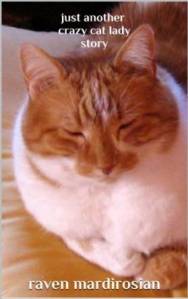
UnknownRaven Mardirosian describes a similar experience in “Just Another Crazy Cat Lady Story” (2014). She had just arrived in Fort Collins, Colorado for graduate school. On the East Coast, she’d left behind her fundamentalist Christian family and her “sort-of” girlfriend at their Christian college, which banished Mardirosian from campus when their relationship was uncovered (by said girlfriend).

It was the beginning of many years of wandering — if not running — and yet there she was in an animal shelter, about to take on the commitment of adopting one of two kittens. She was drawn to the darker one, as the orange tabby reminded her a little too much of the beloved family cat whose loss she still grieved. But when the orange tabby’s tiny white paw grabbed her finger, Mardirosian knew she’d been chosen.

That orange tabby, Avery, became Mardirosian’s link to a kinder, gentler way of being amid a return to the East Coast and a series of jobs, schools, apartments and girlfriends. People in her life asked: When are you going to grow up? When are you going to get right with the Lord? Avery just napped in her lap, knowing she would figure it all out.

While living in New York City, Mardirosian adopted Zoey, a little gray street cat, through a fellow CCL (crazy cat lady). After thoroughly vetting Mardirosian and her living space, CCL brought Zoey for a trial visit.

Zoey turns her eyes my way: jade green, with just enough of a razor slit to show that I’m not the only bitch in the room. …

Then she decides to come over and say hello.

She likes you.

The magical three words. All of the chasing after my parents’ love, the attention of the beautiful redhead or blonde or black-haired girl at Henrietta’s … flies back in one terrifying sword of truth — she likes you — as Zoey remains in my lap, not quite seated, not quite standing.

She does, doesn’t she?

Still, in the beginning there was fearsome hissing and screaming, broken glass and an abscessed injury to the base of Avery’s tail. Though Zoey did settle down, she remained moody and opinionated — much like Idgie, my aforementioned loudmouthed tiger cat.

Mardirosian developed a unique relationship with each of her feline charges: “I’m much more aligned to Zoey, the secret observer. The runner. I’ve got that skill down pat. Avery challenges me to remove the labyrinth that winds its way around my heart and let others love me.”

Her account of Avery’s illness and the agonizing decision to let him go, after nearly two decades of life and love, is wrenching. Though deeply moving in and of itself, it brought back the loss of Idgie, who passed at age 16, quite vividly.

Even in her grief, Mardirosian recognizes, as I did, that her friend and guide is “safe, happy and free. … This crazy cat of mine will fly on. I may not know how — but trust the energy that propels him forward will move me in the same way.”

At our city shelter, I met a tortoiseshell kitten. I picked her up, and she reached out and patted my face with her paw. Lucy is now an easygoing 3-year-old, a very different cat with a new set of lessons.

My education continues.