Chosen by cats

If you are in transition, chances are an animal is or is waiting to be your teacher. Cats in particular choose us for these missions, although some cleverly let us think we do the choosing.

For example: A tiny, loudmouthed tiger kitten adopted me at a Southern Indiana animal shelter when I was just out of graduate school and unsure of the next step. When I picked her up, she looked me straight in the eye and meowed. I’d passed muster.
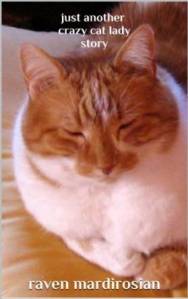
UnknownRaven Mardirosian describes a similar experience in “Just Another Crazy Cat Lady Story” (2014). She had just arrived in Fort Collins, Colorado for graduate school. On the East Coast, she’d left behind her fundamentalist Christian family and her “sort-of” girlfriend at their Christian college, which banished Mardirosian from campus when their relationship was uncovered (by said girlfriend).

It was the beginning of many years of wandering — if not running — and yet there she was in an animal shelter, about to take on the commitment of adopting one of two kittens. She was drawn to the darker one, as the orange tabby reminded her a little too much of the beloved family cat whose loss she still grieved. But when the orange tabby’s tiny white paw grabbed her finger, Mardirosian knew she’d been chosen.

That orange tabby, Avery, became Mardirosian’s link to a kinder, gentler way of being amid a return to the East Coast and a series of jobs, schools, apartments and girlfriends. People in her life asked: When are you going to grow up? When are you going to get right with the Lord? Avery just napped in her lap, knowing she would figure it all out.

While living in New York City, Mardirosian adopted Zoey, a little gray street cat, through a fellow CCL (crazy cat lady). After thoroughly vetting Mardirosian and her living space, CCL brought Zoey for a trial visit.

Zoey turns her eyes my way: jade green, with just enough of a razor slit to show that I’m not the only bitch in the room. …

Then she decides to come over and say hello.

She likes you.

The magical three words. All of the chasing after my parents’ love, the attention of the beautiful redhead or blonde or black-haired girl at Henrietta’s … flies back in one terrifying sword of truth — she likes you — as Zoey remains in my lap, not quite seated, not quite standing.

She does, doesn’t she?

Still, in the beginning there was fearsome hissing and screaming, broken glass and an abscessed injury to the base of Avery’s tail. Though Zoey did settle down, she remained moody and opinionated — much like Idgie, my aforementioned loudmouthed tiger cat.

Mardirosian developed a unique relationship with each of her feline charges: “I’m much more aligned to Zoey, the secret observer. The runner. I’ve got that skill down pat. Avery challenges me to remove the labyrinth that winds its way around my heart and let others love me.”

Her account of Avery’s illness and the agonizing decision to let him go, after nearly two decades of life and love, is wrenching. Though deeply moving in and of itself, it brought back the loss of Idgie, who passed at age 16, quite vividly.

Even in her grief, Mardirosian recognizes, as I did, that her friend and guide is “safe, happy and free. … This crazy cat of mine will fly on. I may not know how — but trust the energy that propels him forward will move me in the same way.”

At our city shelter, I met a tortoiseshell kitten. I picked her up, and she reached out and patted my face with her paw. Lucy is now an easygoing 3-year-old, a very different cat with a new set of lessons.

My education continues.

Within arm’s reach

It’s impossible for me to watch shows like “Ocean Mysteries” and “Sea Rescue” without feeling torn up over the way we are tearing up our world. The seal with the fishing line tightening around its neck, cutting into the flesh. The pelican with the pouch someone slashed with a knife. And of course the oil-covered fish, birds, and other creatures. The lovely image above was the artist’s response to the 2010 Gulf of Mexico oil spill. The world needs to know this and consider the implications, I remind myself. There is more to learn.

A recent episode dealt with a giant Pacific octopus who’d deposited some 20,000 eggs in her habitat at a marine life center. She would care for these eggs constantly. And that would be her final act, as octopuses die around the same time as their eggs hatch. Paul, the World Cup-match-predicting octopus in Germany, only lived to be two and a half years old, and that was considered a normal octopus lifespan.

This is not human cruelty or carelessness; it’s nature. We can do any number of things to take better care of our earth and help where there is hurt. All we can do about the incredible sadness of things like this is to stay present and keep learning.

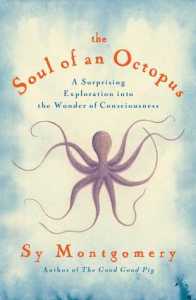
http://www.goodreads.com/book/show/22609485-the-soul-of-an-octopusA short time later, I found The Soul of an Octopus: A Surprising Exploration into the Wonder of Consciousness (Atria Books, 2015) at a bookstore. The book grew out of author Sy Montgomery’s article in Orion magazine about her unique friendship with an octopus named Athena at the New England Aquarium. Octopuses (not octopi, she says) are intelligent creatures who solve problems, change colors according to their health and mood, and recognize the people who care for them.

Most of the book centers around the New England Aquarium and the staff and volunteers who care for a succession of Giant Pacific octopuses there. Montgomery describes her first “handshake” with Athena — octopuses taste with their entire bodies, but their suckers are the most sensitive — as “an exceptionally intimate embrace.” When Athena died suddenly, Montgomery, who felt she was just getting to know this new invertebrate friend, was surprised by her grief.

Other octopuses would cross her path, notably Octavia. “I stroked her head, her arms, her webbing, absorbed in her presence. She seemed equally attentive to me.”  Octavia also mischievously hosed a high school student job-shadowing Montgomery for the day. As Octavia began to age, the aquarium acquired young Kali, an inordinately curious escape artist. Then there was Karma, who arrived with part of her second right arm missing.

Also compelling are the stories of the humans Montgomery works with, including sixteen-year-old volunteer Anna, who has Asperger’s syndrome, a few health problems, and a host of fish tanks at home. “Going behind the scenes at the aquarium changed my life,” she says.

Though I do have reservations about animals such as octopuses being kept in captivity, reputable aquariums serve a valuable purpose. They provide ways to learn about and connect with sea life that would be far less likely or impossible in the wild. This sort of connection translates much more readily to caring and conservation than, say, abstractly hearing over and over again about the importance of conservation. The aquariums that lean more toward amusement parks or other commercial enterprises? Maybe not so much.

Of course, caring comes with a cost, such as feeling torn up inside when animals suffer or natural wonders are trashed. Or grieving over the loss of friends (of any species) whose time on earth seems absurdly short.

Still, we reach out — to hold hands with an octopus, plant a garden, recycle a pop can, or do any other seemingly small thing that keeps the regenerative force of caring alive.

Dog school confidential

51+12AmLdKL._SX329_BO1,204,203,200_When 24-year-old Evie answers an online ad to become a dog trainer, she doesn’t know exactly why. She’s never had a pet and has little experience with dogs. But before she even clicks on the ad, “suddenly I felt that I stood in the doorway of a crowded, noisy room, picking up the sound of a whisper no one else seemed to hear.”

That is key to The Mountaintop School for Dogs and Other Second Chances by Ellen Cooney (Mariner Books, 2014) — learning how to listen in a new way.

The training program is at a mountaintop sanctuary for stray and rescued dogs, and Evie is the lone trainee. There are no classes. There are no instructors. There are only stern innkeeper Mrs. Auberchon, Giant George (a young man with no apparent history or actual age), the older women who run the sanctuary, and a handful of dogs who — accompanied by mysteriously placed case history notes — introduce themselves to Evie, one by one.

Hank is a Lab/pit bull mix left anonymously at a shelter, deemed unadoptable due to aggression. Josie, a small white dog, lived in the lap of luxury until the new baby came along. Her hearing loss was determined to be the result of a recent blow, or several. Tasha is pure Rottweiler; before arriving at the Sanctuary, she was pushed out of a car at a stop sign, adopted twice and returned both times, and barely escaped being adopted by dogfighters.

The dogs, of course, aren’t the only ones with troubled pasts. Evie knows she requires just as much training and re-socializing as her canine charges. Mrs. Auberchon is a lone wolf and determined to remain so. What they have in common is an uncanny knack for communicating with the dogs. Evie “messages” them. Mrs. Auberchon reads to them.

Some aspects of the novel were puzzling. It’s hard to believe such an unstructured dog training program could exist for very long. The sanctuary staffers barely communicate with Evie and show little warmth or welcome. The canine characters, however, were very genuine, as dogs tend to be.

This story is a reminder that there are no bad dogs, as Barbara Woodhouse famously said in her 1982 book. There are dogs with severe limitations, and sadly, we humans are sometimes ill equipped to respond. My rescue dog, a German shepherd-golden retriever-collie mix, joined the household at about two years old, which in dog years is plenty of time to develop life-altering fears and bad habits. Like pulling at the leash and lunging at other dogs, sometimes injuring the human holding the leash who is trying to restrain her or, at the very least, hold on. Or launching herself toward moving bicycles because they frighten her so badly that attacking them seems to be her only option. After three training classes, there is improvement, but unfortunately not enough for walking her to be safe. However, she has a home, and who knows what learning opportunities may unfold?

Finding peace with doing what we can do for abandoned and abused animals, even when that seems woefully inadequate, is humbling. It reminds us to not give up on ourselves. After studying dog breeds and dog training and reading countless case histories, she writes a case note for herself in the form of a haiku:

Came in as a stray.
Is not completely hopeless.
Please allow to stay.